Skip to main content
Cell Biology
My Course
Learn
Exam Prep
AI Tutor
Study Guides
Flashcards
Explore
Try the app
My Course
Learn
Exam Prep
AI Tutor
Study Guides
Flashcards
Explore
Try the app
Back
Model Organisms definitions
You can tap to flip the card.
Model Organism
You can tap to flip the card.
👆
Model Organism
An organism selected for research due to rapid reproduction, genetic manipulability, and biological similarity to humans.
Track progress
Control buttons has been changed to "navigation" mode.
1/15
Related flashcards
Related practice
Recommended videos
Model Organisms quiz #1
Model Organisms
10 Terms
Model Organisms
1. Overview of Cell Biology
7 problems
Topic
Viruses
1. Overview of Cell Biology
7 problems
Topic
1. Overview of Cell Biology - Part 1 of 2
5 topics
14 problems
Chapter
1. Overview of Cell Biology - Part 2 of 2
5 topics
13 problems
Chapter
Guided course
04:06
Cell Culture
471
views
7
rank
1
comments
Guided course
07:15
Top Main Model Organisms
608
views
9
rank
1
comments
Guided course
03:11
Purpose of Model Organisms
712
views
7
rank
Terms in this set (15)
Hide definitions
Model Organism
An organism selected for research due to rapid reproduction, genetic manipulability, and biological similarity to humans.
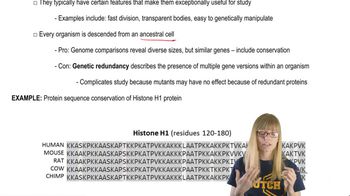
Genetic Redundancy
The presence of multiple gene copies with similar functions, complicating mutant analysis in research.
Conservation
A phenomenon where gene or protein sequences remain highly similar across different species.
E. coli
A prokaryotic bacterium used for rapid division, DNA replication, and protein production in labs.
Yeast
A single-celled eukaryote with a small genome, ideal for genetic screens and rapid laboratory growth.
Genetic Screen
A technique involving mutagenesis to identify genes responsible for specific phenotypes.
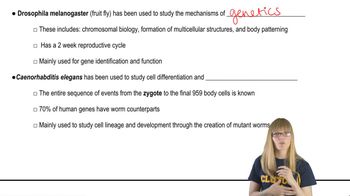
Drosophila melanogaster
A fruit fly model used for studying genetics, chromosomal biology, and developmental patterning.
C. elegans
A transparent nematode with a fully mapped cell lineage, valuable for developmental biology studies.
Arabidopsis
A small flowering plant with a genome size similar to humans, used for plant genetics research.
Zebrafish
A vertebrate with transparent embryos, facilitating observation of internal development and gene function.
Frog
An amphibian model with large eggs, useful for studying cell division and whole genome duplication.
Mouse
A mammalian model sharing 99% of protein-coding genes with humans, crucial for disease research.
Cell Culture
A laboratory method for growing cells in vitro to study cellular mechanisms and responses.
Retrovirus
An RNA virus capable of integrating its genetic material into host chromosomes, enabling gene insertion.
HeLa Cells
A human cervical cancer cell line widely used in cell culture for biological and medical research.
 BackBack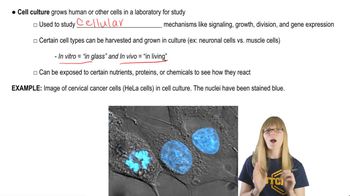
 04:06
04:06