Skip to main content
Cell Biology
My Course
Learn
Exam Prep
AI Tutor
Study Guides
Flashcards
Explore
Try the app
My Course
Learn
Exam Prep
AI Tutor
Study Guides
Flashcards
Explore
Try the app
Back
Overview of Tissue Structures definitions
You can tap to flip the card.
Extracellular Matrix
You can tap to flip the card.
👆
Extracellular Matrix
Network of proteins providing structural support and connectivity among cells in multicellular organisms.
Track progress
Control buttons has been changed to "navigation" mode.
1/16
Related flashcards
Related practice
Recommended videos
Overview of Tissue Structures quiz #1
Overview of Tissue Structures
27 Terms
Overview of Tissue Structures
1. Overview of Cell Biology
7 problems
Topic
Viruses
1. Overview of Cell Biology
7 problems
Topic
1. Overview of Cell Biology - Part 1 of 2
5 topics
14 problems
Chapter
1. Overview of Cell Biology - Part 2 of 2
5 topics
13 problems
Chapter
Guided course
06:01
Cells to Tissues
412
views
3
rank
Guided course
06:05
Multicellular Development
330
views
3
rank
Terms in this set (16)
Hide definitions
Extracellular Matrix
Network of proteins providing structural support and connectivity among cells in multicellular organisms.
Cell Adhesion Molecules
Proteins in animals that attach cells to each other, enabling tissue formation and integrity.
Plasmodesmata
Cytoplasmic bridges in plants that connect cell walls, allowing communication and transport between cells.
Basal Lamina
Protein-rich layer supporting groups of epithelial cells, contributing to tissue structure and stability.
Ground Tissue
Plant tissue responsible for metabolism and facilitating nutrient flow between other tissue types.
Dermal Tissue
Plant tissue forming a protective outer layer and aiding in nutrient absorption.
Vascular Tissue
Plant tissue specialized for transporting water and nutrients throughout the organism.
Epithelial Tissue
Animal tissue forming protective sheets that cover body surfaces and line cavities.
Connective Tissue
Animal tissue providing mechanical support and structure, including bone.
Blood
Fluid tissue in animals responsible for transporting oxygen and other substances.
Nervous Tissue
Animal tissue specialized for transmitting electrical signals throughout the body.
Muscle Tissue
Animal tissue enabling movement by contracting and relaxing in response to stimuli.
Zygote
Single initial cell from which a multicellular organism develops, giving rise to all tissues.
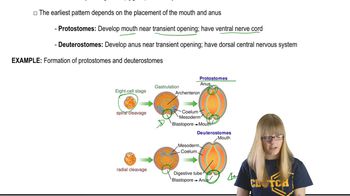
Protostomes
Group of organisms where the mouth forms near the initial embryonic opening and possess a ventral nerve cord.
Deuterostomes
Group of organisms where the anus forms near the initial embryonic opening and have a dorsal central nervous system.
Patterning Genes
Conserved transcription factors directing timing and location of tissue and organ development.
 BackBack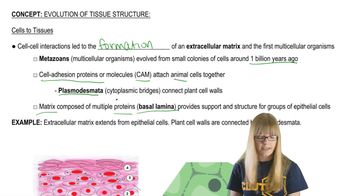
 06:01
06:01