Skip to main content
Cell Biology
My Course
Learn
Exam Prep
AI Tutor
Study Guides
Flashcards
Explore
Try the app
My Course
Learn
Exam Prep
AI Tutor
Study Guides
Flashcards
Explore
Try the app
Back
Phosphoinositide Signaling Pathways definitions
You can tap to flip the card.
Phosphoinositide
You can tap to flip the card.
👆
Phosphoinositide
A membrane lipid that, when cleaved or phosphorylated, initiates multiple intracellular signaling cascades.
Track progress
Control buttons has been changed to "navigation" mode.
1/14
Related flashcards
Related practice
Recommended videos
Phosphoinositide Signaling Pathways quiz
Phosphoinositide Signaling Pathways
15 Terms
Phosphoinositide Signaling Pathways
14. Cell Signaling
7 problems
Topic
Integration of Multiple Signaling Pathways
14. Cell Signaling
7 problems
Topic
14. Cell Signaling - Part 1 of 2
4 topics
12 problems
Chapter
14. Cell Signaling - Part 2 of 2
4 topics
12 problems
Chapter
Guided course
04:14
PI Pathway
560
views
4
rank
1
comments
Terms in this set (14)
Hide definitions
Phosphoinositide
A membrane lipid that, when cleaved or phosphorylated, initiates multiple intracellular signaling cascades.
G Protein-Coupled Receptor
A cell surface protein that detects external signals and activates intracellular G proteins to relay messages.
Receptor Tyrosine Kinase
A membrane receptor that, upon ligand binding, triggers phosphorylation events leading to diverse cellular responses.
Gq Protein
A G protein subtype that, when activated, stimulates phospholipase C to propagate signaling.
Phospholipase C
An enzyme that cleaves inositol phospholipids, generating molecules that further transmit signals inside the cell.
Inositol Trisphosphate
A small molecule produced by lipid cleavage that releases calcium from internal stores into the cytoplasm.
Diacylglycerol
A lipid-derived molecule that, together with calcium, activates protein kinase C to modulate cellular activities.
Calcium
A versatile signaling ion whose cytoplasmic increase triggers processes like muscle contraction and secretion.
Protein Kinase C
A kinase activated by diacylglycerol and calcium, responsible for phosphorylating various target proteins.
PI 3-Kinase
An enzyme recruited to membranes that phosphorylates phosphoinositides, initiating survival and growth signals.
AKT
A protein activated downstream of PI 3-kinase, regulating cell survival, growth, and metabolism.
P10 Phosphatase
A phosphatase that terminates signaling by removing phosphates from phosphoinositides, inactivating the pathway.
Signaling Cascade
A series of sequential molecular events amplifying and transmitting signals from receptors to cellular targets.
Cytokine Receptor
A receptor type that, like RTKs, can activate phospholipase C to initiate intracellular signaling.
 BackBack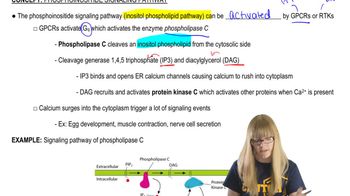
 04:14
04:14