Skip to main content
Cell Biology
My Course
Learn
Exam Prep
AI Tutor
Study Guides
Flashcards
Explore
Try the app
My Course
Learn
Exam Prep
AI Tutor
Study Guides
Flashcards
Explore
Try the app
Back
Phosphoinositide Signaling Pathways quiz
You can tap to flip the card.
What are the two main types of receptors that can activate phosphoinositide signaling pathways?
You can tap to flip the card.
👆
What are the two main types of receptors that can activate phosphoinositide signaling pathways?
G protein-coupled receptors (GPCRs) and receptor tyrosine kinases (RTKs) can both activate phosphoinositide signaling pathways.
Track progress
Control buttons has been changed to "navigation" mode.
1/15
Related flashcards
Related practice
Recommended videos
Phosphoinositide Signaling Pathways definitions
Phosphoinositide Signaling Pathways
14 Terms
Phosphoinositide Signaling Pathways
14. Cell Signaling
7 problems
Topic
Integration of Multiple Signaling Pathways
14. Cell Signaling
7 problems
Topic
14. Cell Signaling - Part 1 of 2
4 topics
12 problems
Chapter
14. Cell Signaling - Part 2 of 2
4 topics
12 problems
Chapter
Guided course
04:14
PI Pathway
560
views
4
rank
1
comments
Terms in this set (15)
Hide definitions
What are the two main types of receptors that can activate phosphoinositide signaling pathways?
G protein-coupled receptors (GPCRs) and receptor tyrosine kinases (RTKs) can both activate phosphoinositide signaling pathways.
Which G protein is activated by GPCRs in the phosphoinositide signaling pathway?
The Gq protein is activated by GPCRs in this pathway.
What enzyme does the Gq protein activate in the phosphoinositide pathway?
Gq activates phospholipase C.
What are the two products formed when phospholipase C cleaves an inositol phospholipid?
The two products are inositol trisphosphate (IP3) and diacylglycerol (DAG).
What is the main function of IP3 in the cell?
IP3 triggers the release of calcium into the cytoplasm, leading to calcium signaling.
What does DAG do after being produced in the phosphoinositide pathway?
DAG activates protein kinase C (PKC) in the presence of calcium.
Name three cellular processes that are triggered by calcium signaling.
Calcium signaling is involved in egg development, muscle contraction, and nerve cell secretion.
How do RTKs activate the phosphoinositide signaling pathway differently from GPCRs?
RTKs activate phospholipase C, which then recruits PI 3-kinase to the membrane, leading to further signaling cascades.
What is the role of PI 3-kinase in the RTK-activated pathway?
PI 3-kinase phosphorylates phosphoinositol lipids, initiating signaling cascades that can trigger cell division and prevent cell death.
Which protein is activated downstream of PI 3-kinase in the RTK pathway?
AKT is activated downstream of PI 3-kinase.
What is the function of AKT in the phosphoinositide signaling pathway?
AKT activates a variety of downstream proteins involved in cell survival and growth.
How is the phosphoinositide signaling pathway inactivated?
The pathway is inactivated by the phosphatase P10, which removes phosphates from phosphoinositol lipids.
What is the alternative name for the phosphoinositide signaling pathway?
It is also called the inositol phospholipid pathway.
What is the role of protein kinase C (PKC) in the phosphoinositide pathway?
PKC is activated by DAG and calcium, and it goes on to activate other proteins in the cell.
Why is calcium considered a crucial signaling molecule in this pathway?
Calcium acts as a second messenger, triggering various cellular events such as secretion, contraction, and development.
 BackBack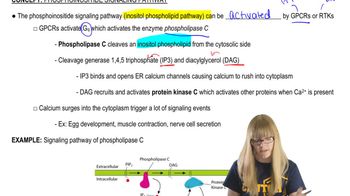
 04:14
04:14