Skip to main content
Cell Biology
My Course
Learn
Exam Prep
AI Tutor
Study Guides
Flashcards
Explore
Try the app
My Course
Learn
Exam Prep
AI Tutor
Study Guides
Flashcards
Explore
Try the app
Back
Post-Transcriptional Regulators definitions
You can tap to flip the card.
RNA Processing
You can tap to flip the card.
👆
RNA Processing
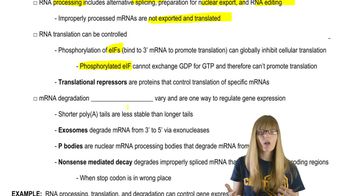
Cellular events like splicing, export, and editing that determine if RNA becomes mature and ready for translation.
Track progress
Control buttons has been changed to "navigation" mode.
1/15
Related flashcards
Related practice
Recommended videos
Post-Transcriptional Regulators quiz
Post-Transcriptional Regulators
15 Terms
Post-Transcriptional Regulators
7. Gene Expression
7 problems
Topic
Action of Transcriptional Regulators
7. Gene Expression
7 problems
Topic
7. Gene Expression
5 topics
15 problems
Chapter
Guided course
05:59
RNA Interference
370
views
2
comments
Guided course
03:45
RNA Regulation
351
views
Guided course
02:30
Protein Regulation
299
views
1
comments
Terms in this set (15)
Hide definitions
RNA Processing
Cellular events like splicing, export, and editing that determine if RNA becomes mature and ready for translation.
Translation
The process where ribosomes synthesize proteins from mature mRNA, tightly regulated to control gene expression.
mRNA Degradation
The breakdown of messenger RNA, influenced by factors like poly A tail length, impacting gene expression levels.
Exosome
A multi-protein complex that degrades RNA molecules from the 3' to 5' end using exonucleases.
P-body
A cytoplasmic or nuclear region where mRNA is stored, processed, or degraded, contributing to gene regulation.
Nonsense-Mediated Decay
A surveillance pathway that degrades mRNAs with premature stop codons, preventing faulty protein production.
RNA Interference
A gene-silencing mechanism using small RNAs to target and degrade specific mRNAs, defending against viruses.
siRNA
Double-stranded RNA fragments processed by Dicer, guiding RISC to degrade complementary viral or foreign mRNAs.
miRNA
Genome-encoded single-stranded RNAs forming hairpins, processed to regulate hundreds of mRNAs via RISC-mediated degradation.
RISC Complex
A protein assembly that binds small RNAs, enabling sequence-specific mRNA recognition and degradation.
Dicer
An enzyme that cleaves double-stranded RNAs into small fragments, initiating RNA interference pathways.
Argonaute
A core RISC component responsible for cleaving target mRNAs bound by guide RNAs.
Phosphorylation
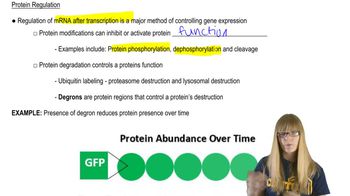
A protein modification involving phosphate addition, altering protein activity and gene expression outcomes.
Ubiquitin
A small protein that tags other proteins for degradation by the proteasome or lysosome.
Degron
A specific protein region or sequence that signals for targeted protein degradation, controlling protein lifespan.
 BackBack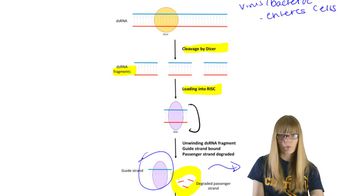
 05:59
05:59