Skip to main content
Cell Biology
My Course
Learn
Exam Prep
AI Tutor
Study Guides
Flashcards
Explore
Try the app
My Course
Learn
Exam Prep
AI Tutor
Study Guides
Flashcards
Explore
Try the app
Back
Post-Transcriptional Regulators quiz
You can tap to flip the card.
What are the three main processes involved in post-transcriptional regulation of gene expression?
You can tap to flip the card.
👆
What are the three main processes involved in post-transcriptional regulation of gene expression?
The three main processes are RNA processing, translation, and degradation.
Track progress
Control buttons has been changed to "navigation" mode.
1/15
Related flashcards
Related practice
Recommended videos
Post-Transcriptional Regulators definitions
Post-Transcriptional Regulators
15 Terms
Post-Transcriptional Regulators
7. Gene Expression
7 problems
Topic
Action of Transcriptional Regulators
7. Gene Expression
7 problems
Topic
7. Gene Expression
5 topics
15 problems
Chapter
Guided course
05:59
RNA Interference
370
views
2
comments
Guided course
03:45
RNA Regulation
351
views
Guided course
02:30
Protein Regulation
299
views
1
comments
Terms in this set (15)
Hide definitions
What are the three main processes involved in post-transcriptional regulation of gene expression?
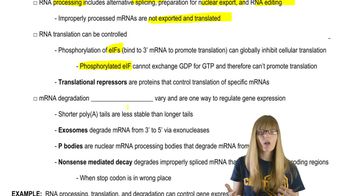
The three main processes are RNA processing, translation, and degradation.
How does improper RNA processing affect mRNA export and translation?
Improperly processed RNAs remain in the nucleus and are not exported or translated.
What role do phosphorylated EIFs play in translation regulation?
Phosphorylated EIFs inhibit translation by preventing GTP hydrolysis, thus blocking mRNA translation.
How do translational repressors impact gene expression?
Translational repressors are proteins that inhibit translation of mRNA, thereby reducing gene expression.
What determines the stability and degradation rate of mRNA transcripts?
The length of the poly A tail determines mRNA stability; shorter tails lead to faster degradation.
What are exosomes and how do they contribute to mRNA degradation?
Exosomes are complexes that degrade mRNA from the 3' to 5' end using exonucleases.
What is the function of p-bodies in mRNA regulation?
P-bodies are nuclear mRNA processing bodies that degrade mRNA as part of gene regulation.
What triggers nonsense-mediated decay in mRNA?
Nonsense-mediated decay is triggered by improperly spliced mRNA, such as those with misplaced stop codons.
What is RNA interference (RNAi) and its primary function?
RNA interference uses regulatory RNAs to control gene expression by degrading specific mRNAs.
How do siRNAs protect cells from viruses?
siRNAs are double-stranded RNAs that, after processing by dicer and the RISC complex, degrade viral mRNAs.
What is the role of the RISC complex in RNA interference?
The RISC complex binds single-stranded siRNA or miRNA and degrades complementary mRNA.
How are microRNAs (miRNAs) processed and how do they regulate gene expression?
miRNAs are transcribed, form hairpin structures, are processed by drosia and dicer, then bind RISC to degrade mRNAs.
What region of mRNA do microRNAs typically bind to for gene regulation?
MicroRNAs usually bind to the 3' untranslated region (UTR) of mRNAs to inhibit expression.
What are degrons and how do they affect protein regulation?
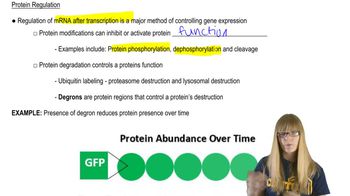
Degrons are regions of a protein that mark it for degradation, controlling protein presence and function.
How does ubiquitin labeling lead to protein degradation?
Ubiquitin labeling targets proteins for destruction by the proteasome or lysosome.
 BackBack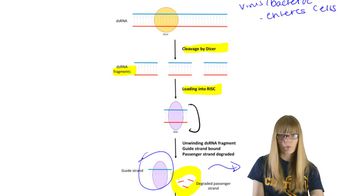
 05:59
05:59