Skip to main content
Cell Biology
My Course
Learn
Exam Prep
AI Tutor
Study Guides
Flashcards
Explore
Try the app
My Course
Learn
Exam Prep
AI Tutor
Study Guides
Flashcards
Explore
Try the app
Back
Protein Basics definitions
You can tap to flip the card.
Amino Acid
You can tap to flip the card.
👆
Amino Acid
Building block with a central carbon, amino group, carboxyl group, hydrogen, and a unique side chain determining its properties.
Track progress
Control buttons has been changed to "navigation" mode.
1/15
Related flashcards
Related practice
Recommended videos
Protein Basics quiz
Protein Basics
15 Terms
Protein Basics
6. Proteins
7 problems
Topic
Protein Folding
6. Proteins
7 problems
Topic
6. Proteins - Part 1 of 2
3 topics
9 problems
Chapter
6. Proteins - Part 2 of 2
3 topics
9 problems
Chapter
Guided course
02:19
Four Protein Models
795
views
5
rank
2
comments
Guided course
02:35
Protein Structures
1490
views
32
rank
3
comments
Guided course
07:25
Protein Folding
975
views
19
rank
Terms in this set (15)
Hide definitions
Amino Acid
Building block with a central carbon, amino group, carboxyl group, hydrogen, and a unique side chain determining its properties.
Polypeptide Chain
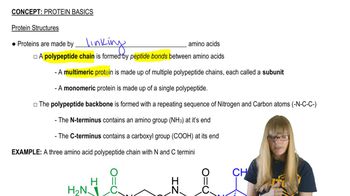
Linear sequence formed by linking amino acids via peptide bonds, serving as the foundation for protein structure.
Peptide Bond
Covalent linkage between the carboxyl group of one amino acid and the amino group of another, forming the protein backbone.
R Group
Variable side chain attached to the central carbon of an amino acid, responsible for its unique chemical behavior.
Monomeric Protein
Molecule composed of a single polypeptide chain, representing the simplest form of protein structure.
Multimeric Protein
Complex composed of multiple polypeptide chains, each referred to as a subunit, functioning together.
Subunit
Individual polypeptide chain within a multimeric protein, contributing to the overall structure and function.
Polypeptide Backbone
Repeating sequence of nitrogen and carbon atoms forming the core structure of a protein chain.
N Terminus
End of a polypeptide chain featuring a free amino group, marking the starting point of protein synthesis.
C Terminus
End of a polypeptide chain with a free carboxyl group, indicating the chain's completion.
Conformation
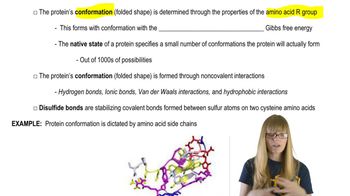
Specific three-dimensional folded shape of a protein, determined by its amino acid sequence and side chain interactions.
Denatured Protein
Unfolded state lacking functional structure, often caused by heat or pH changes, but sometimes reversible.
Disulfide Bond
Covalent linkage between sulfur atoms of two cysteine residues, providing extra stability to protein structure.
Chaperone Protein
Helper molecule assisting in the proper folding or refolding of other proteins, preventing misfolding and aggregation.
Chaperonin
Specialized complex forming a chamber that isolates unfolded proteins, allowing correct folding in a protected environment.
 BackBack
 02:19
02:19