What type of bond links amino acids together to form a polypeptide chain?
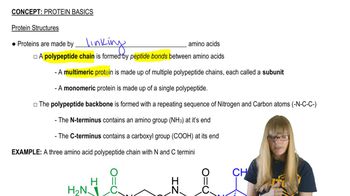
Amino acids are linked together by peptide bonds to form a polypeptide chain.
What is the difference between a monomeric and a multimeric protein?
A monomeric protein consists of a single polypeptide chain, while a multimeric protein has multiple polypeptide chains called subunits.
What are the two ends of a polypeptide chain called, and what groups do they have?
The two ends are the N-terminus, which has an amino group (NH3), and the C-terminus, which has a carboxyl group (COOH).
What part of an amino acid gives it its unique properties?
The R group, or side chain, of an amino acid gives it its unique properties.
What are the four main categories of amino acid R groups?
The four main categories are polar charged, polar uncharged, non-polar, and 'other' (special cases).
Which stereoisomer form of amino acids is used in proteins?
Only the L form of amino acids is used in proteins.
What is meant by the term 'protein conformation'?
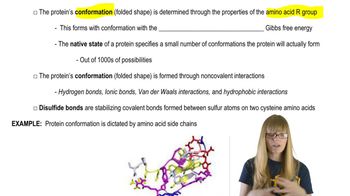
Protein conformation refers to the folded, three-dimensional shape of a protein.
What restricts the folding of a polypeptide chain?
Folding is restricted by the peptide bonds in the polypeptide backbone and by the requirement to reach the lowest Gibbs free energy.
What is a denatured protein, and can it refold?
A denatured protein is unfolded, and many proteins can refold (renature) under proper conditions.
What types of interactions primarily stabilize protein conformation?
Protein conformation is primarily stabilized by non-covalent interactions such as hydrogen bonds, ionic bonds, van der Waals forces, and hydrophobic interactions.
What is a disulfide bond and what role does it play in proteins?
A disulfide bond is a covalent bond formed between sulfur atoms of two cysteine residues, providing extra stability to protein structure.
What are chaperone proteins and what do they do?
Chaperone proteins assist in the folding of other proteins, either by stabilizing unfolded proteins (molecular chaperones) or providing a controlled environment for folding (chaperonins).
How do molecular chaperones and chaperonins differ in their function?
Molecular chaperones bind to and stabilize unfolded proteins, while chaperonins provide a chamber for proteins to fold away from the cellular environment.
What are the four models used to represent protein structure?
The four models are the backbone model, ribbon model, wire model, and space-filling model.
What does the space-filling model of a protein show?
The space-filling model shows a contour map of the protein's surface, highlighting its overall shape and surface features.
 Back
Back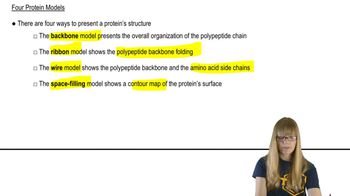
 02:19
02:19