Skip to main content
Cell Biology
My Course
Learn
Exam Prep
AI Tutor
Study Guides
Flashcards
Explore
Try the app
My Course
Learn
Exam Prep
AI Tutor
Study Guides
Flashcards
Explore
Try the app
Back
The Innate Immune Response definitions
You can tap to flip the card.
Innate Immune Response
You can tap to flip the card.
👆
Innate Immune Response
First line of defense, acting rapidly and non-specifically to eliminate pathogens using barriers, cells, and proteins.
Track progress
Control buttons has been changed to "navigation" mode.
1/13
Related flashcards
Related practice
Recommended videos
The Innate Immune Response quiz #1
The Innate Immune Response
10 Terms
The Innate Immune Response
21. The Immune System
7 problems
Topic
B Cell Development
21. The Immune System
7 problems
Topic
21. The Immune System - Part 1 of 2
4 topics
11 problems
Chapter
21. The Immune System - Part 2 of 2
4 topics
10 problems
Chapter
Guided course
08:49
Innate Immunity
340
views
6
rank
Terms in this set (13)
Hide definitions
Innate Immune Response
First line of defense, acting rapidly and non-specifically to eliminate pathogens using barriers, cells, and proteins.
Chemical Barriers
Substances like enzymes or acidic pH that prevent pathogen entry or survival at body surfaces.
Physical Barriers
Structures such as skin and mucous membranes that block pathogen invasion.
Cell Intrinsic Responses
Defensive actions performed by individual cells to halt pathogen replication or spread.
Phagocytic Cells
White blood cells that engulf and destroy pathogens, often traveling through the body to infection sites.
Pathogen Associated Molecular Patterns
Molecular features common to groups of microbes, recognized as foreign by immune cells.
Pattern Recognition Receptors
Proteins on immune cells that detect conserved microbial structures, triggering immune activation.
Toll-like Receptors
A major class of pattern recognition receptors that bind microbial patterns and initiate immune signaling.
Complement System
A group of about 20 blood proteins that, once activated, help eliminate pathogens by various mechanisms.
Natural Killer Cells
Immune cells that detect infected cells and induce their self-destruction to prevent pathogen spread.
Apoptosis
Programmed cell death, used by immune cells to eliminate infected or damaged cells.
Inflammation
Localized response involving heat, pain, and swelling, recruiting immune cells to infection sites.
Dendritic Cells
Cells that bridge innate and adaptive immunity by recognizing pathogens and activating adaptive responses.
 BackBack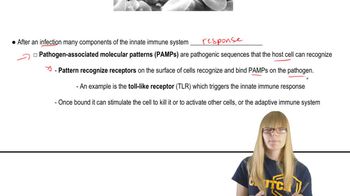
 08:49
08:49