Skip to main content
Cell Biology
My Course
Learn
Exam Prep
AI Tutor
Study Guides
Flashcards
Explore
Try the app
My Course
Learn
Exam Prep
AI Tutor
Study Guides
Flashcards
Explore
Try the app
Back
Tumor Viruses quiz
You can tap to flip the card.
What is another name for tumor viruses?
You can tap to flip the card.
👆
What is another name for tumor viruses?
Tumor viruses are also called oncogenic viruses.
Track progress
Control buttons has been changed to "navigation" mode.
1/15
Related flashcards
Related practice
Recommended videos
Tumor Viruses definitions
Tumor Viruses
15 Terms
Tumor Viruses
20. Cancer
7 problems
Topic
Metastasis and Cancer Spread
20. Cancer
7 problems
Topic
20. Cancer - Part 1 of 2
3 topics
9 problems
Chapter
20. Cancer - Part 2 of 2
3 topics
9 problems
Chapter
Guided course
04:32
Tumor Viruses
338
views
3
rank
Terms in this set (15)
Hide definitions
What is another name for tumor viruses?
Tumor viruses are also called oncogenic viruses.
How can tumor viruses cause cancer by interacting with the host genome?
They can integrate their genome into the host cell's DNA, potentially disrupting important genes and leading to cancer.
What is one example of a host gene that, if disrupted by a viral genome, can lead to cancer?
The RAS gene, which is often mutated in cancers, can be disrupted if a viral genome integrates into it.
How can viral proteins promote cancer without integrating into the host genome?
Viral proteins can interfere with normal cell functions, such as blocking tumor suppressors or altering cell cycle control and apoptosis.
What effect does blocking tumor suppressor activity have on a cell?
Blocking tumor suppressor activity leads to a loss of tumor suppressor function, increasing the risk of cancer.
Why might a virus want to decrease apoptosis in an infected cell?
Decreasing apoptosis allows the infected cell to survive longer, giving the virus more time to replicate.
How do some viruses use the host cell's machinery for their own benefit?
They produce proteins that take over the cell's replication machinery to replicate the viral genome.
Which viruses are associated with liver cancer?
Hepatitis B and C viruses are associated with liver cancer.
What types of cancer are linked to Human Papillomavirus (HPV)?
HPV is linked to cervical, head, neck, and throat cancers.
Which virus is associated with Kaposi sarcoma, especially in immunocompromised individuals?
Herpes virus is associated with Kaposi sarcoma, particularly in people with weakened immune systems like those with AIDS.
How does HIV indirectly increase the risk of Kaposi sarcoma?
HIV weakens the immune system, making it easier for herpes virus infections to cause Kaposi sarcoma.
What are the two key proteins expressed by HPV that interfere with cell functions?
HPV expresses the E6 and E7 proteins.
What is the function of the HPV E6 protein in cancer development?
E6 binds to and leads to the destruction of the p53 tumor suppressor, promoting cancer.
How does the HPV E7 protein contribute to cancer?
E7 binds to the Retinoblastoma Tumor Suppressor and inhibits its function, increasing the likelihood of cancer.
Why is the loss of tumor suppressor activity significant in cancer development?
Loss of tumor suppressor activity removes important controls on cell growth and division, making cancer more likely.
 BackBack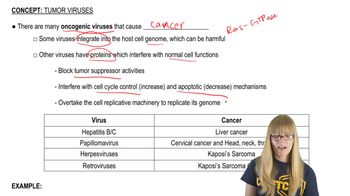
 04:32
04:32