Skip to main content
Cell Biology
My Course
Learn
Exam Prep
AI Tutor
Study Guides
Flashcards
Explore
Try the app
My Course
Learn
Exam Prep
AI Tutor
Study Guides
Flashcards
Explore
Try the app
Back
Viruses definitions
You can tap to flip the card.
Capsid
You can tap to flip the card.
👆
Capsid
Protein shell enclosing genetic material, often with helical or icosahedral geometry, providing structure and protection.
Track progress
Control buttons has been changed to "navigation" mode.
1/15
Related flashcards
Related practice
Recommended videos
Viruses quiz #1
Viruses
10 Terms
Viruses
1. Overview of Cell Biology
7 problems
Topic
Overview of Tissue Structures
1. Overview of Cell Biology
7 problems
Topic
1. Overview of Cell Biology - Part 1 of 2
5 topics
14 problems
Chapter
1. Overview of Cell Biology - Part 2 of 2
5 topics
13 problems
Chapter
Guided course
03:49
Viruses for Research
439
views
8
rank
Guided course
01:57
Viroids and Prions
433
views
6
rank
Guided course
10:52
Viruses
542
views
7
rank
Terms in this set (15)
Hide definitions
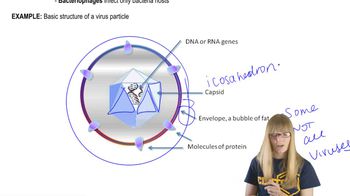
Capsid
Protein shell enclosing genetic material, often with helical or icosahedral geometry, providing structure and protection.
Envelope
Phospholipid bilayer surrounding some viral capsids, derived from host membranes, aiding in host cell entry.
Bacteriophage
Virus specialized to infect bacteria, often used as a model in studies of viral life cycles.
Lytic Cycle
Viral process resulting in new particle production and host cell destruction, releasing virions.
Lysogenic Cycle
Viral process where genetic material integrates into host genome, remaining dormant until reactivated.
Prophage
Integrated viral DNA within a bacterial genome during lysogenic cycle, capable of later activation.
Provirus
Integrated viral DNA within a eukaryotic host genome, allowing for potential gene expression and reactivation.
Plaque Assay
Laboratory method to quantify viruses by counting clear zones formed by infected, lysed cells in a culture.
Retrovirus
Enveloped RNA virus using reverse transcription to integrate its genome into host DNA, enabling gene manipulation.
Reverse Transcription
Process converting RNA into DNA, essential for retroviral genome integration into host chromosomes.
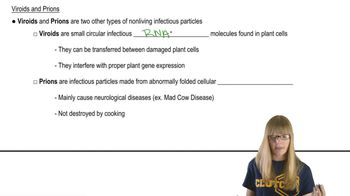
Viroid
Small, circular infectious RNA molecule in plants, interfering with protein function by binding and blocking activity.
Prion
Infectious, abnormally folded protein causing diseases like mad cow disease, resistant to destruction by cooking.
Virion
Complete, infectious viral particle released from host cells, capable of initiating new infections.
Receptor
Host cell surface protein recognized by viruses, facilitating viral attachment and entry.
Helical Shape
Capsid structure characterized by a spiral arrangement of protein subunits around the viral genome.
 BackBack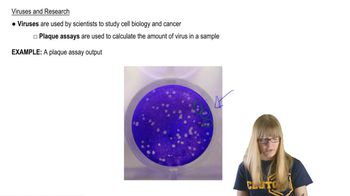
 03:49
03:49