Back
Glycolysis and Fermentation: Chemotrophic Energy Metabolism in Cells
Study Guide - Smart Notes
 Tailored notes based on your materials, expanded with key definitions, examples, and context.
Glycolysis and Fermentation
Overview of Cellular Energy Metabolism
Cells capture energy by oxidizing food molecules, storing it in the covalent bonds of energy-carrying molecules such as ATP. Glycolysis is a central pathway for generating ATP, and its products can enter either fermentation or aerobic respiration depending on cellular conditions.
Metabolism encompasses all chemical reactions in the cell, organized into metabolic pathways.
Anabolic pathways build complex molecules from simpler ones, requiring energy.
Catabolic pathways break down molecules, releasing energy.
Pathways can be anaerobic (without oxygen) or aerobic (with oxygen).
Energy Storage and ATP
ATP and Other Energy Carriers
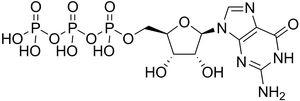
Cells store energy primarily in the form of ATP, but also use GTP (which can be converted to ATP) and reduced coenzymes such as NADH and FADH2.
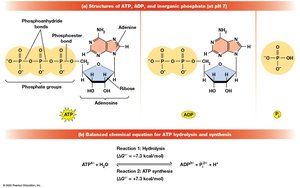
ATP (Adenosine Triphosphate) is a nucleotide with three phosphate groups (alpha, beta, gamma).
Other carriers: NADH, FADH2 are reduced coenzymes that store high-energy electrons.
ATP Hydrolysis and Energy Release
ATP hydrolysis is a highly exergonic reaction, releasing energy that can be used for cellular work.
ATP → ADP + Pi: ΔG°' = -7.3 kcal/mol
ADP → AMP + Pi: ΔG°' = -7.3 kcal/mol
AMP → adenosine + Pi: ΔG°' = -3.6 kcal/mol
Why Is ATP Hydrolysis Exergonic?
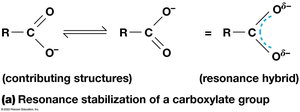
The exergonic nature of ATP hydrolysis is due to several factors:
Charge repulsion between negatively charged phosphate groups.
Resonance stabilization of the inorganic phosphate product.
Increased entropy (disorder) after hydrolysis.
ATP in Cellular Work
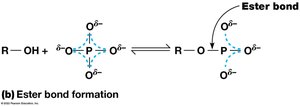
ATP is not only an energy currency but also participates in phosphorylation reactions, transferring phosphate groups to other molecules to activate or deactivate them.
Energy Conservation in the Cell
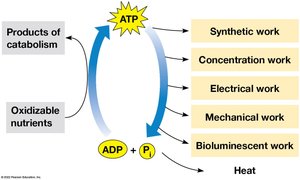
Cells use ATP to drive various types of work, including biosynthesis, transport, mechanical movement, and more.
Redox Reactions in Metabolism
Role of Redox in Chemotrophic Energy Metabolism
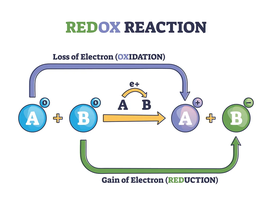
Redox reactions are central to energy metabolism. Oxidation is the loss of electrons, while reduction is the gain of electrons (OIL RIG: Oxidation Is Losing, Reduction Is Gaining).
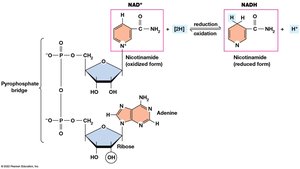
Electrons (often as hydrogen atoms) are transferred to coenzymes such as NAD+, FAD, and NADP+.
These reduced coenzymes (NADH, FADH2, NADPH) carry electrons to the electron transport chain or to other metabolic pathways.
Glucose as an Energy Source
Glucose Oxidation
Glucose is a primary energy source for most cells. Its complete oxidation to CO2 and H2O is highly exergonic:
ΔG = -686 kcal/mol
Glucose is oxidized to CO2; oxygen is reduced to water.
Aerobes and Anaerobes
Obligate aerobes require oxygen for survival.
Obligate anaerobes cannot survive in the presence of oxygen.
Facultative organisms can switch between aerobic and anaerobic metabolism.
Glycolysis
General Features
Glycolysis is an anaerobic pathway that partially oxidizes glucose to produce pyruvate, ATP, and NADH. It occurs in the cytosol and is present in nearly all organisms.
Products: pyruvate, ATP, NADH
ATP is generated by substrate-level phosphorylation.
Phases of Glycolysis
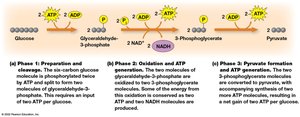
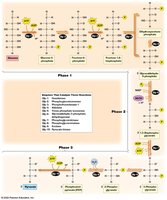
Glycolysis consists of three main phases:
Phase 1: Preparation and cleavage
Phase 2: Oxidation
Phase 3: Production of pyruvate
Preparation Phase
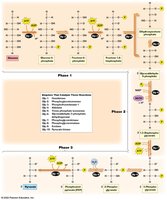
In this phase, glucose is phosphorylated and split into two three-carbon molecules (dihydroxyacetone phosphate and glyceraldehyde-3-phosphate). This phase consumes 2 ATP per glucose.
Glucose + 2 ATP → 2 G3P + 2 ADP
Payoff Phase
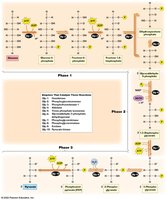
The payoff phase generates ATP and NADH as G3P is converted to pyruvate. Each glucose yields two G3P, so all reactions in this phase occur twice per glucose.
G3P + NAD+ + Pi + ADP → 3-phosphoglycerate + NADH + H+ + ATP
3-phosphoglycerate is further converted to pyruvate, generating additional ATP.
Total Yields of Glycolysis
For each glucose molecule:
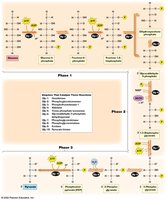
Gross ATP produced: 4
ATP consumed: 2
Net ATP yield: 2 per glucose
2 NADH and 2 pyruvate are also produced.
Fermentation
Fate of Pyruvate Under Anaerobic Conditions
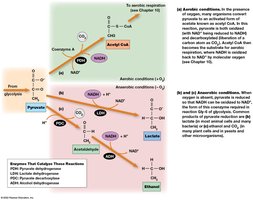
When oxygen is absent, cells regenerate NAD+ by reducing pyruvate through fermentation. The main types are:
Lactic acid fermentation: Pyruvate is reduced to lactate, regenerating NAD+.
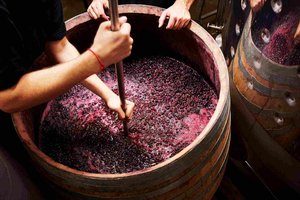
Alcoholic fermentation: Pyruvate is converted to ethanol and CO2, also regenerating NAD+.
Implications for Cancer
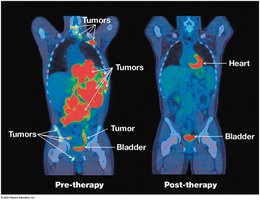
Cancer cells often rely on glycolysis and fermentation for rapid energy production, even in the presence of oxygen (the Warburg effect).
Alternative Substrates and Gluconeogenesis
Alternative Substrates for Glycolysis
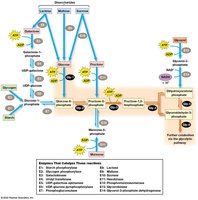
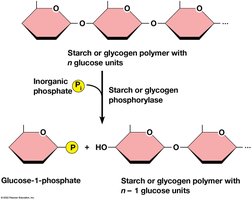
Cells can utilize other carbohydrates (such as glycogen, starch, and various sugars) by converting them into glycolytic intermediates.
Gluconeogenesis
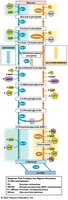
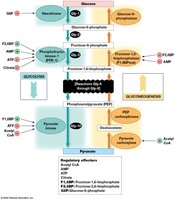
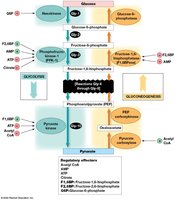
Gluconeogenesis is the synthesis of glucose from non-carbohydrate precursors. It is not a simple reversal of glycolysis, as three steps (Gly-1, Gly-3, Gly-10) are bypassed by unique enzymes.
Regulation of Glycolysis and Gluconeogenesis
Allosteric Regulation
Key enzymes in glycolysis and gluconeogenesis are regulated allosterically to ensure reciprocal control:
Glycolysis: Hexokinase, Phosphofructokinase-1, Pyruvate kinase
Gluconeogenesis: Fructose-1,6-bisphosphatase, Pyruvate carboxylase
Reciprocal Regulation
Several metabolites act as regulators:
AMP: Activates glycolysis, inhibits gluconeogenesis
Fructose-2,6-bisphosphate: Activates glycolysis, inhibits gluconeogenesis
Acetyl-CoA: Activates gluconeogenesis, inhibits glycolysis
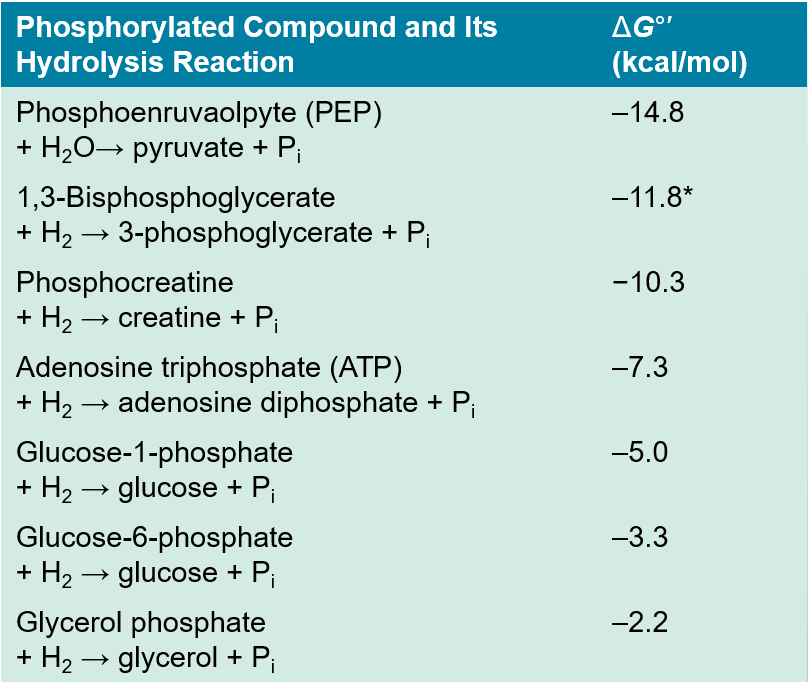
Appendix: Table of Phosphorylated Compounds and Hydrolysis Free Energies
The following table summarizes the standard free energy changes (ΔG°') for hydrolysis of key phosphorylated compounds:
Phosphorylated Compound and Its Hydrolysis Reaction | ΔG°' (kcal/mol) |
|---|---|
Phosphoenolpyruvate (PEP) + H2O → pyruvate + Pi | –14.8 |
1,3-Bisphosphoglycerate + H2O → 3-phosphoglycerate + Pi | –11.8 |
Phosphocreatine + H2O → creatine + Pi | –10.3 |
Adenosine triphosphate (ATP) + H2O → adenosine diphosphate + Pi | –7.3 |
Glucose-1-phosphate + H2O → glucose + Pi | –5.0 |
Glucose-6-phosphate + H2O → glucose + Pi | –3.3 |
Glycerol phosphate + H2O → glycerol + Pi | –2.2 |