Skip to main content
College Algebra
My Course
Learn
Exam Prep
AI Tutor
Study Guides
Textbook Solutions
Flashcards
Explore
Try the app
My Course
Learn
Exam Prep
AI Tutor
Study Guides
Textbook Solutions
Flashcards
Explore
Try the app
Back
Arithmetic Sequences quiz
You can tap to flip the card.
What is the defining characteristic of an arithmetic sequence?
You can tap to flip the card.
👆
What is the defining characteristic of an arithmetic sequence?
An arithmetic sequence has a constant difference, called the common difference (d), between consecutive terms.
Track progress
Control buttons has been changed to "navigation" mode.
1/15
Related flashcards
Related practice
Recommended videos
Arithmetic Sequences definitions
Arithmetic Sequences
15 Terms
Arithmetic Sequences
9. Sequences, Series, & Induction
4 problems
Topic
Callie
Geometric Sequences
9. Sequences, Series, & Induction
4 problems
Topic
Callie
9. Sequences, Series, & Induction
3 topics
6 problems
Chapter
Callie
Guided course
7:00
Example 2
844
views
5
rank
Guided course
2:35
Example 1
779
views
1
rank
Guided course
6:40
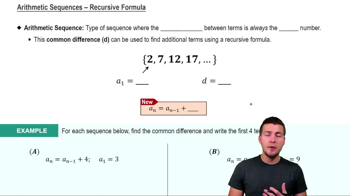
Arithmetic Sequences - Recursive Formula
1433
views
5
rank
Terms in this set (15)
Hide definitions
What is the defining characteristic of an arithmetic sequence?
An arithmetic sequence has a constant difference, called the common difference (d), between consecutive terms.
How do you find the common difference in an arithmetic sequence?
Subtract any term from the next term in the sequence; the result is the common difference d.
What is the recursive formula for an arithmetic sequence?
The recursive formula is an = an-1 + d, where d is the common difference and the first term is specified.
Why must you specify the first term when writing a recursive formula for an arithmetic sequence?
Without the first term, you wouldn't know where to start the sequence, so it's necessary to specify it.
What is the general formula for the nth term of an arithmetic sequence?
The general formula is an = a1 + d(n-1), where a1 is the first term and d is the common difference.
How does the general formula differ from the recursive formula for arithmetic sequences?
The general formula allows you to find any term directly using n, while the recursive formula requires knowing the previous term.
If the first term of an arithmetic sequence is 3 and the common difference is 4, what are the first four terms?
The first four terms are 3, 7, 11, and 15.
In the sequence 9, 3, -3, -9, what is the common difference?
The common difference is -6.
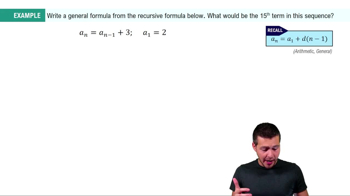
How do you write a recursive formula for the sequence 2, 5, 8, 11, 14?
The recursive formula is an = an-1 + 3, with a1 = 2.
What is the value of the 4th term in the sequence defined by a1 = 2 and d = 5?
The 4th term is 17.
How would you use the general formula to find the 101st term of the sequence 2, 5, 8, 11, 14?
Plug n = 101 into the formula: a101 = 2 + 3(101-1) = 302.
What does the variable n represent in the general formula for arithmetic sequences?
n represents the position of the term in the sequence.
Can the common difference in an arithmetic sequence be negative?
Yes, the common difference can be negative, causing the sequence to decrease.
Why is the general formula useful for finding terms with large indices?
It allows you to calculate any term directly without computing all previous terms.
What two pieces of information do you need to write the general formula for an arithmetic sequence?
You need the first term (a1) and the common difference (d).
 BackBack
 7:00
7:00