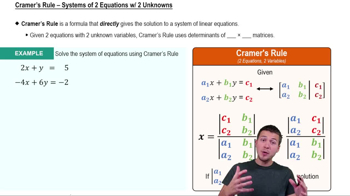
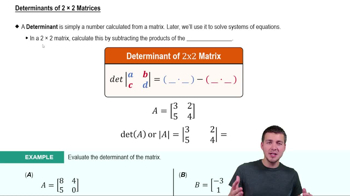
Cramer's Rule is used to solve systems of equations using determinants of matrices.
How do you set up matrices for Cramer's Rule in a system of two equations with two unknowns?
Create matrices by replacing columns of coefficients with the constants from the equations for each variable.
What is the process for finding x using Cramer's Rule in a 2x2 system?
Replace the x column with the constants, calculate its determinant, and divide by the determinant of the coefficient matrix.
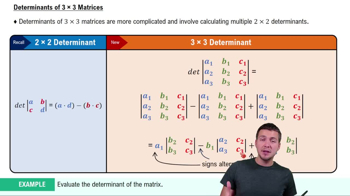
How do you calculate the determinant of a 3x3 matrix?
Expand along the first row, multiplying each element by the determinant of its corresponding 2x2 submatrix, alternating signs.
What is the sign pattern when expanding a 3x3 determinant?
The signs alternate: plus, minus, plus, for the terms in the expansion.
How do you form the 2x2 submatrices when calculating a 3x3 determinant?
For each element in the first row, remove its row and column to form the 2x2 submatrix.
What is the determinant of the 3x3 matrix [[3,1,0],[0,2,-3],[-1,4,6]]?
The determinant is 3, calculated by expanding and evaluating the 2x2 submatrices.
How do you use Cramer's Rule to solve a system of three equations with three unknowns?
Replace each variable's column with the constants, calculate the determinant, and divide by the determinant of the coefficient matrix for x, y, and z.
What does it mean if the determinant of the coefficient matrix is zero when using Cramer's Rule?
It means the system has no unique solution; Cramer's Rule cannot be applied.
How do you calculate dx, dy, and dz for Cramer's Rule in a 3x3 system?
Replace the respective variable's column with the constants, calculate the determinant for each, and divide by the determinant of the original coefficient matrix.
What is the solution to the system if dx = -15, dy = 15, dz = -18, and the determinant of the coefficient matrix is -3?
x = 5, y = -5, z = 6, found by dividing each determinant by -3.
 Back
Back

 7:25
7:25