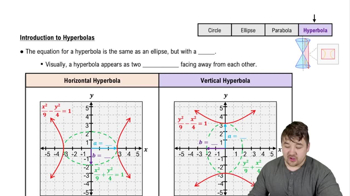
What is the key difference between the standard equations of an ellipse and a hyperbola?
The ellipse uses a plus sign between the terms, while the hyperbola uses a minus sign.
How does the visual appearance of a hyperbola differ from an ellipse?
A hyperbola looks like two parabolas facing away from each other, while an ellipse is a closed oval shape.
In the equation of a hyperbola, what does the 'a' value represent?
The 'a' value is the distance from the center to each vertex of the hyperbola.
How is the 'b' value used when graphing a hyperbola?
The 'b' value helps determine the height of the hyperbola and is critical for finding the asymptotes.
For a vertical hyperbola, where is the 'a' value located in the equation?
The 'a' value is under the y squared term in the denominator.
How do you determine if a hyperbola is horizontal or vertical from its equation?
If the x squared term comes first, it's horizontal; if the y squared term comes first, it's vertical.
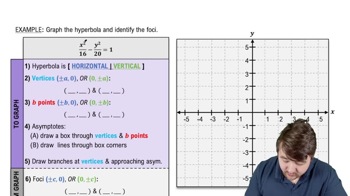
Where are the vertices and foci located for a horizontal hyperbola centered at the origin?
They are on the x-axis at (±a, 0) for vertices and (±c, 0) for foci.
What is the formula for finding the foci distance 'c' in a hyperbola?
c² = a² + b²; c is the square root of the sum of a² and b².
How is the foci of a hyperbola unique compared to other conic sections?
For any point on the hyperbola, the difference of the distances to the two foci is constant.
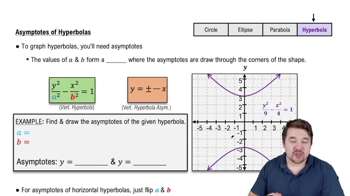
What is the process for graphing the asymptotes of a hyperbola?
Draw a box using the a and b values, then draw diagonal lines through the corners of the box.
What is the equation for the asymptotes of a vertical hyperbola centered at the origin?
y = ±(a/b)x, where a is the vertical distance and b is the horizontal distance.
How do you find the equations for the asymptotes of a horizontal hyperbola?
The equations are y = ±(b/a)x, flipping the a and b values compared to the vertical case.
What are the steps to graph a hyperbola from its equation?
Determine orientation, find vertices, find b points, draw the box, draw asymptotes, and sketch the hyperbola branches.
How do you find the vertices of a hyperbola given its equation?
Take the square root of the first denominator term (a²), then plot points at (±a, 0) or (0, ±a) depending on orientation.
What is the main difference in the sign usage between hyperbola and ellipse equations?
Hyperbolas use a minus sign in their standard equation and a plus sign in the foci formula, while ellipses use a plus sign in the equation and a minus sign in the foci formula.
 Back
Back
 5:50
5:50