Skip to main content
College Algebra
My Course
Learn
Exam Prep
AI Tutor
Study Guides
Textbook Solutions
Flashcards
Explore
Try the app
My Course
Learn
Exam Prep
AI Tutor
Study Guides
Textbook Solutions
Flashcards
Explore
Try the app
Back
Hyperbolas NOT at the Origin quiz
You can tap to flip the card.
What is the standard form equation for a hyperbola not centered at the origin?
You can tap to flip the card.
👆
What is the standard form equation for a hyperbola not centered at the origin?
The standard form is ((y - k)^2)/a^2 - ((x - h)^2)/b^2 = 1 for a vertical hyperbola, where (h, k) is the center.
Track progress
Control buttons has been changed to "navigation" mode.
1/15
Related flashcards
Related practice
Recommended videos
Hyperbolas NOT at the Origin definitions
Hyperbolas NOT at the Origin
15 Terms
Hyperbolas NOT at the Origin
8. Conic Sections
3 problems
Topic
Callie
Hyperbolas at the Origin
8. Conic Sections
2 problems
Topic
Callie
8. Conic Sections
6 topics
8 problems
Chapter
Callie
Guided course
5:59
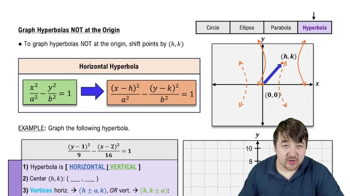
Graph Hyperbolas NOT at the Origin
889
views
1
rank
Terms in this set (15)
Hide definitions
What is the standard form equation for a hyperbola not centered at the origin?
The standard form is ((y - k)^2)/a^2 - ((x - h)^2)/b^2 = 1 for a vertical hyperbola, where (h, k) is the center.
How do you determine the center of a hyperbola from its equation?
The center is (h, k), where h is subtracted from x and k is subtracted from y in the equation.
What does the 'h' value represent in the hyperbola's equation?
The 'h' value represents the horizontal shift of the center from the origin.
What does the 'k' value represent in the hyperbola's equation?
The 'k' value represents the vertical shift of the center from the origin.
How do you identify if a hyperbola is vertical or horizontal from its equation?
If the y-term is positive and comes first, the hyperbola is vertical; if the x-term is positive and comes first, it is horizontal.
How do you find the vertices of a vertical hyperbola not at the origin?
Keep h constant and add and subtract 'a' from k to get the vertices at (h, k + a) and (h, k - a).
How do you calculate the value of 'a' in the hyperbola's equation?
'a' is the square root of the denominator under the positive term in the equation.
How do you find the 'b' points for a vertical hyperbola?
Keep k constant and add and subtract 'b' from h to get the points (h + b, k) and (h - b, k).
How do you calculate the value of 'b' in the hyperbola's equation?
'b' is the square root of the denominator under the negative term in the equation.
What is the relationship between a, b, and c in a hyperbola?
The relationship is c^2 = a^2 + b^2, where c is the distance from the center to each focus.
How do you find the coordinates of the foci for a vertical hyperbola?
Keep h constant and add and subtract 'c' from k to get (h, k + c) and (h, k - c).
How do you graph the asymptotes of a hyperbola not at the origin?
Draw a rectangle using the vertices and b points, then draw lines through the diagonals of the rectangle.
What is the purpose of drawing a box when graphing a hyperbola?
The box helps locate the vertices and b points and guides the drawing of the asymptotes.
How do the branches of a hyperbola relate to the asymptotes?
The branches start at the vertices and approach the asymptotes but never cross them.
What changes in the equation of a hyperbola when it is shifted from the origin?
The variables x and y are replaced with (x - h) and (y - k), shifting the center to (h, k).
 BackBack
 5:59
5:59