What is a matrix in the context of systems of equations?
A matrix is a way to organize numbers from a system of equations into a grid of rows and columns, representing the coefficients and constants without the variables.
How do you determine the size of a matrix?
The size of a matrix is given by the number of rows by the number of columns, such as a 2 by 3 matrix for 2 rows and 3 columns.
What is an augmented matrix?
An augmented matrix is a matrix that includes the coefficients and constants from a system of equations, separated by a bar that represents the equals sign.
What do you do if a variable is missing in an equation when forming a matrix?
If a variable is missing, you place a 0 in the corresponding position in the matrix to indicate its coefficient is zero.
What are the three basic row operations you can perform on a matrix?
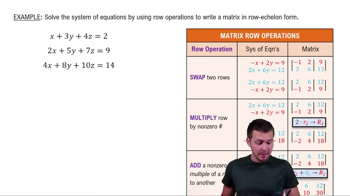
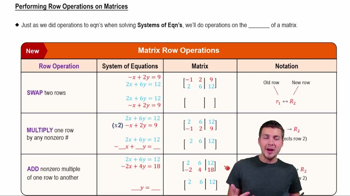
The three basic row operations are swapping two rows, multiplying a row by a non-zero number, and adding a multiple of one row to another.
Why can't you multiply a row by zero in a matrix?
Multiplying a row by zero would effectively delete the equation, which is not allowed because it removes information from the system.
What is the purpose of swapping two rows in a matrix?
Swapping two rows changes their positions, which can help arrange the matrix to make solving easier, such as getting a leading 1 in the desired position.
How do you use row operations to get zeros below the diagonal in a matrix?
You add a multiple of one row to another to create zeros below the diagonal, which is essential for achieving row echelon form.
What is row echelon form?
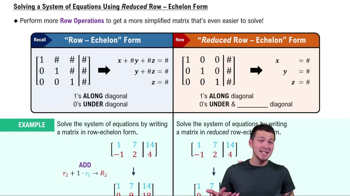
Row echelon form is when a matrix has ones along the diagonal from top left to bottom right and zeros below the diagonal, making back substitution possible.
What is the main difference between row echelon form and reduced row echelon form?
Reduced row echelon form has ones along the diagonal and zeros both below and above the diagonal, while row echelon form only requires zeros below the diagonal.
What is Gaussian elimination?
Gaussian elimination is the process of using row operations to convert a matrix to row echelon form to solve a system of equations.
What is Gauss-Jordan elimination?
Gauss-Jordan elimination is the process of using row operations to convert a matrix to reduced row echelon form, allowing you to read the solution directly.
Why is reduced row echelon form useful for solving systems of equations?
Reduced row echelon form allows you to immediately see the solutions for each variable without needing further substitution.
When should you use addition versus multiplication in row operations?
Use addition to create zeros in a row, and multiplication to turn a coefficient into 1, especially when forming ones along the diagonal.
What is back substitution in the context of solving matrices?
Back substitution is the process of solving for variables starting from the bottom equation and substituting upwards, used after achieving row echelon form.
 Back
Back
 8:38
8:38