Skip to main content
College Algebra
My Course
Learn
Exam Prep
AI Tutor
Study Guides
Textbook Solutions
Flashcards
Explore
Try the app
My Course
Learn
Exam Prep
AI Tutor
Study Guides
Textbook Solutions
Flashcards
Explore
Try the app
Back
Rational Exponents quiz
You can tap to flip the card.
How can the square root of a number be expressed using exponents?
You can tap to flip the card.
👆
How can the square root of a number be expressed using exponents?
The square root of a number can be written as the number raised to the power of one-half.
Track progress
Control buttons has been changed to "navigation" mode.
1/15
Related flashcards
Related practice
Recommended videos
Rational Exponents definitions
Rational Exponents
15 Terms
Rational Exponents
0. Review of Algebra
4 problems
Topic
Callie
0. Review of Algebra - Part 1 of 2
5 topics
10 problems
Chapter
Callie
0. Review of Algebra - Part 2 of 2
3 topics
10 problems
Chapter
Callie
Guided course
04:06
Rational Exponents
3221
views
146
rank
1
comments
Terms in this set (15)
Hide definitions
How can the square root of a number be expressed using exponents?
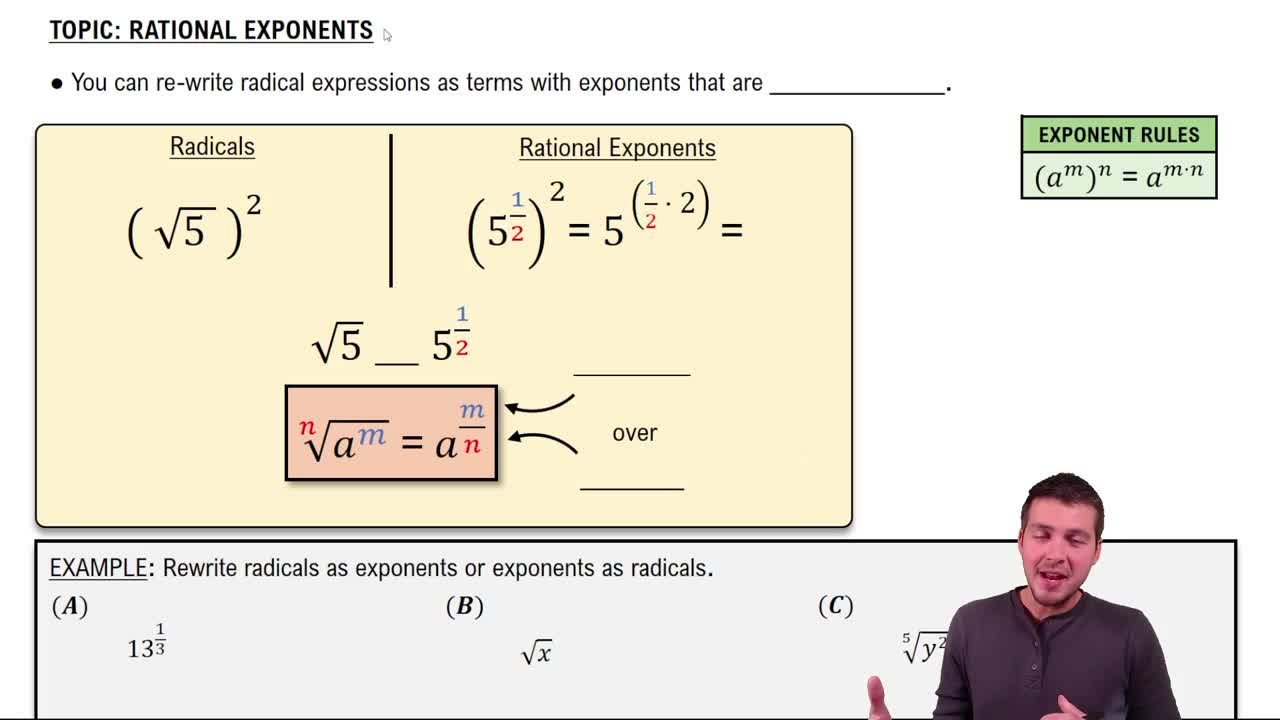
The square root of a number can be written as the number raised to the power of one-half.
What is a rational exponent?
A rational exponent is an exponent that is a fraction, representing both a power and a root.
How do you convert the cube root of 13 to an exponent?
The cube root of 13 is written as 13 to the one-third power, or 13^(1/3).
What does the denominator of a fractional exponent represent?
The denominator represents the index or root of the radical.
What does the numerator of a fractional exponent represent?
The numerator represents the power of the term inside the radical.
How would you write the square root of x as an exponent?
The square root of x is written as x^(1/2).
How do you convert y squared under a fifth root to a rational exponent?
It becomes y^(2/5), with 2 as the numerator and 5 as the denominator.
What is the relationship between squaring a number and taking its square root?
Squaring and taking the square root are inverse operations.
How do you convert 5^(1/2) to a radical expression?
5^(1/2) is equivalent to the square root of 5.
What happens when you square 5^(1/2)?
You get 5, because (5^(1/2))^2 = 5^(1/2*2) = 5^1.
How do you convert a radical with an invisible index to a rational exponent?
The invisible index is 2 for square roots, so the exponent is 1/2.
How do you convert 13^(1/3) to a radical?
13^(1/3) is the cube root of 13.
How do you convert a radical expression with a variable to a rational exponent?
The variable under the root becomes the base, and the exponent is 1 divided by the index.
What is the general rule for converting radicals to rational exponents?
The power inside the radical becomes the numerator, and the index becomes the denominator.
Why are rational exponents also called fractional exponents?
Because they are written as fractions, representing both a power and a root.
 BackBack
 04:06
04:06