Skip to main content
College Algebra
My Course
Learn
Exam Prep
AI Tutor
Study Guides
Textbook Solutions
Flashcards
Explore
Try the app
My Course
Learn
Exam Prep
AI Tutor
Study Guides
Textbook Solutions
Flashcards
Explore
Try the app
Back
Rationalize Denominator quiz
You can tap to flip the card.
What does it mean to rationalize the denominator?
You can tap to flip the card.
👆
What does it mean to rationalize the denominator?
Rationalizing the denominator means eliminating any radicals from the bottom of a fraction.
Track progress
Control buttons has been changed to "navigation" mode.
1/15
Related flashcards
Related practice
Recommended videos
Rationalize Denominator definitions
Rationalize Denominator
15 Terms
Rational Exponents
0. Review of Algebra
4 problems
Topic
Callie
0. Review of Algebra - Part 1 of 2
5 topics
10 problems
Chapter
Callie
0. Review of Algebra - Part 2 of 2
3 topics
10 problems
Chapter
Callie
Guided course
03:42
Rationalizing Denominators Using Conjugates
1630
views
14
rank
Guided course
02:58
Rationalizing Denominators
2155
views
27
rank
Terms in this set (15)
Hide definitions
What does it mean to rationalize the denominator?
Rationalizing the denominator means eliminating any radicals from the bottom of a fraction.
Why can't you leave a radical in the denominator of a fraction?
It's a mathematical convention that radicals should not be left in the denominator; they must be removed to simplify the expression.
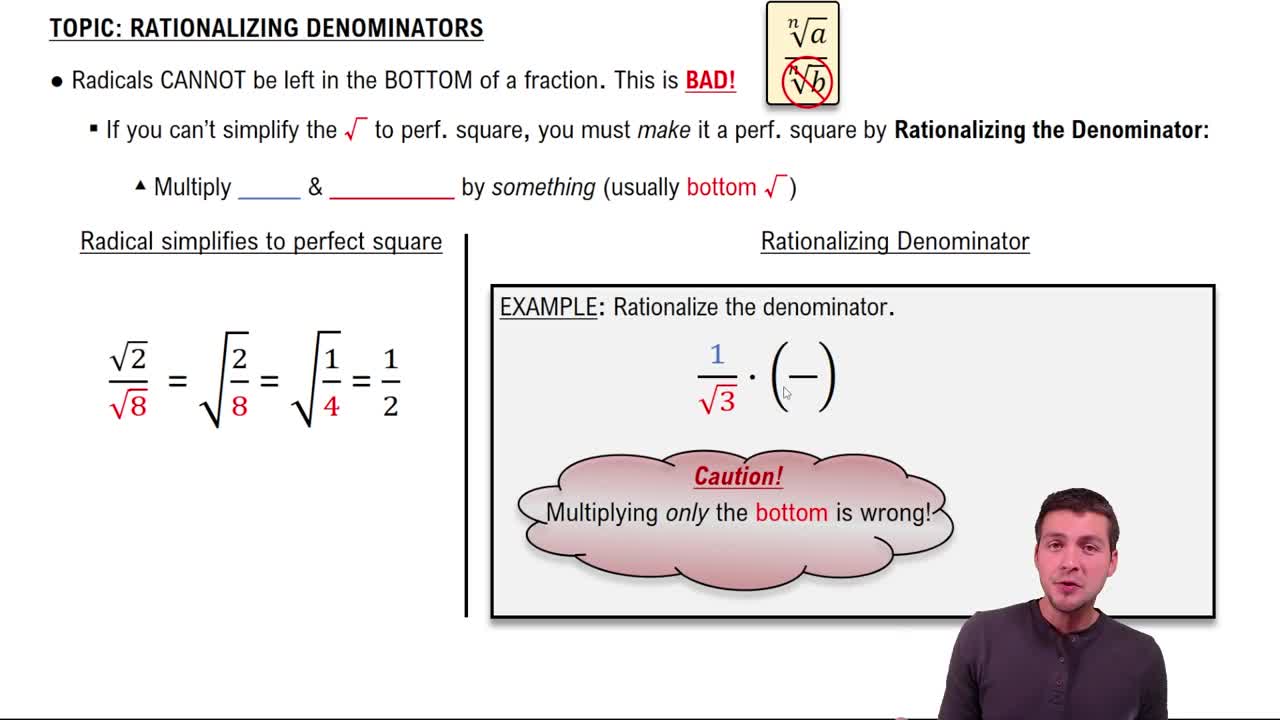
What do you multiply by to rationalize a denominator with a single radical term?
You multiply both the numerator and denominator by the radical itself.
What is the result of multiplying radical 3 by radical 3?
Multiplying radical 3 by radical 3 gives 3, which is a rational number.
If you have 1 over radical 3, what do you multiply by to rationalize the denominator?
You multiply both the numerator and denominator by radical 3.
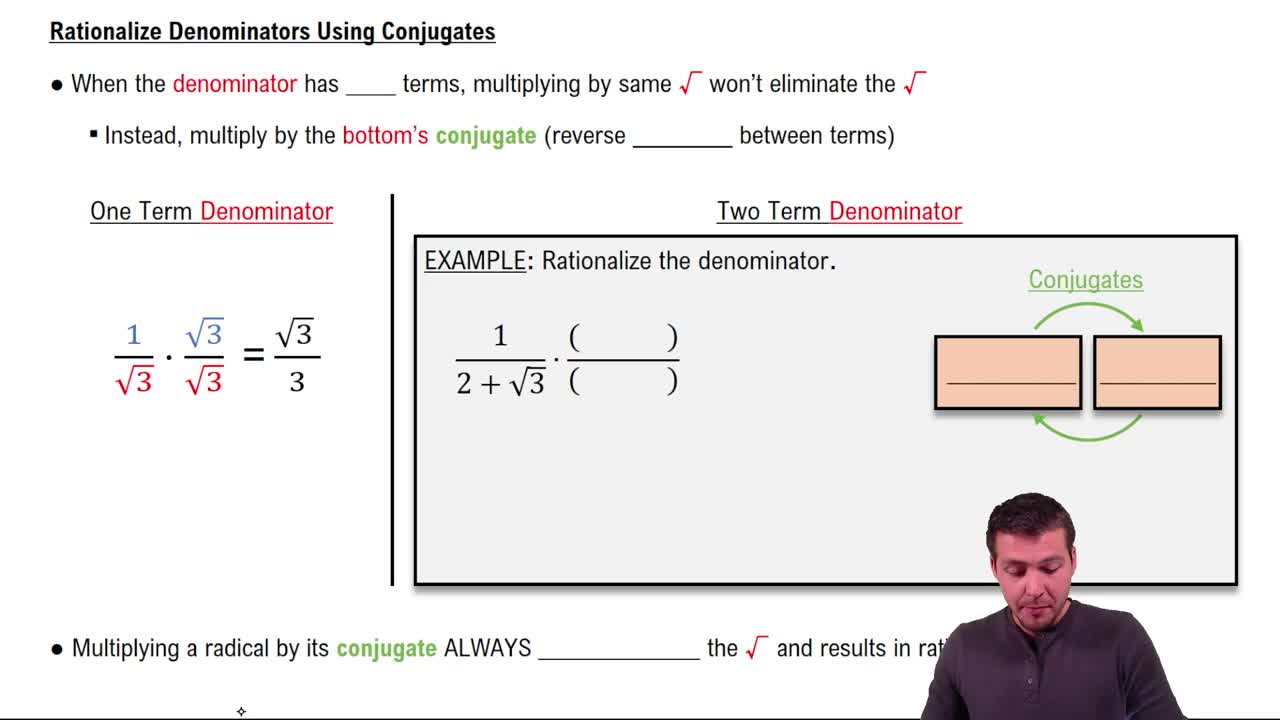
What is the conjugate of 2 + radical 3?
The conjugate of 2 + radical 3 is 2 - radical 3.
Why do you use the conjugate to rationalize denominators with two terms?
Using the conjugate eliminates the radical by creating a difference of squares in the denominator.
What is the general formula for the conjugate of a + radical b?
The conjugate is a - radical b.
What happens when you multiply a binomial by its conjugate?
Multiplying a binomial by its conjugate results in a difference of squares, removing the radical.
What do you always have to do to both the numerator and denominator when rationalizing?
You must multiply both the numerator and denominator by the same value to keep the fraction equivalent.
What is the simplified form of 1 over radical 3 after rationalizing the denominator?
The simplified form is radical 3 over 3.
What is the simplified denominator when you multiply (2 + radical 3) by its conjugate (2 - radical 3)?
The denominator becomes 4 - 3, which simplifies to 1.
What is the result of rationalizing 1 over (2 + radical 3)?
The result is (2 - radical 3) over 1, or just 2 - radical 3.
When is it acceptable to have a radical in a fraction?
It is acceptable to have a radical in the numerator, but not in the denominator.
What are the two main methods for rationalizing denominators?
Multiply by the radical for single-term denominators, and by the conjugate for two-term denominators.
 BackBack
 03:42
03:42