A system of equations consists of multiple equations that must be satisfied simultaneously. The solution is the set of values that make all equations true at the same time.
How can you determine if a point is a solution to a system of equations graphically?
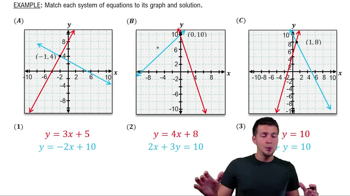
A point is a solution if it lies on all the lines representing the equations in the system. This means it is the intersection point of the lines.
What is the main difference between solving a single equation and a system of equations?
A single equation has many solutions along its line, while a system of equations usually has only one solution where all lines intersect. The system's solution must satisfy all equations simultaneously.
What is the substitution method for solving systems of equations?
The substitution method involves isolating one variable in one equation and substituting its expression into the other equation. This reduces the system to a single equation with one variable.
What are the basic steps of the substitution method?
First, isolate a variable in one equation; second, substitute this expression into the other equation; third, solve for the remaining variable; fourth, substitute back to find the other variable; fifth, check your solution in both equations.
Why is the elimination method useful for solving systems of equations?
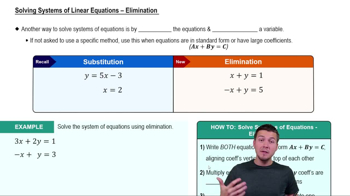
The elimination method allows you to add or subtract equations to eliminate one variable, making it easier to solve for the remaining variable. It is especially useful when equations are in standard form.
What is the first step in the elimination method?
Write both equations in standard form and align the coefficients vertically. This makes it easier to add or subtract the equations.
How do you decide what to multiply equations by in the elimination method?
Multiply one or both equations by numbers so that the coefficients of one variable become equal and opposite, allowing that variable to be eliminated when the equations are added.
What happens if the coefficients of a variable are equal and opposite in the elimination method?
You can add the equations directly, and the variable will cancel out, leaving an equation with only one variable.
What should you do if the coefficients of a variable are equal with the same sign in the elimination method?
Multiply one equation by -1 to make the coefficients equal and opposite, then add the equations to eliminate the variable.
How do you handle coefficients that are factors of each other in the elimination method?
Multiply the equation with the smaller coefficient by the quotient of the larger divided by the smaller (possibly with a negative sign) to make the coefficients equal and opposite.
What is a consistent independent system of equations?
A consistent independent system has exactly one solution, which is the intersection point of the lines. The equations represent lines that cross at a single point.
What is a consistent dependent system of equations?
A consistent dependent system has infinitely many solutions because the equations represent the same line. Every point on the line is a solution.
What is an inconsistent system of equations?
An inconsistent system has no solution because the equations represent parallel lines that never intersect. No pair of values satisfies both equations.
How can you check your solution to a system of equations?
Plug the values you found for the variables into both original equations. If both equations yield true statements, your solution is correct.
 Back
Back
 3:09
3:09