Skip to main content
Financial Accounting
My Course
Learn
Exam Prep
AI Tutor
Study Guides
Flashcards
Explore
Try the app
My Course
Learn
Exam Prep
AI Tutor
Study Guides
Flashcards
Explore
Try the app
Back
Issuing Par Value Stock quiz
You can tap to flip the card.
What does issuing common stock represent for a company?
You can tap to flip the card.
👆
What does issuing common stock represent for a company?
Issuing common stock represents selling equity in the company, not generating revenue.
Track progress
Control buttons has been changed to "navigation" mode.
1/15
Related flashcards
Related practice
Recommended videos
Issuing Par Value Stock definitions
Issuing Par Value Stock
15 Terms
Issuing Par Value Stock
12. Stockholders' Equity
10 problems
Topic
Issuing No Par Value Stock
12. Stockholders' Equity
10 problems
Topic
12. Stockholders' Equity
12 topics
15 problems
Chapter
Guided course
05:26
Issuing Par Value Stock above Par Value
1080
views
47
rank
Guided course
03:10
Issuing Par Value Stock Definitions
1438
views
34
rank
Guided course
04:03
Issuing Par Value Stock at Par Value
1189
views
31
rank
Terms in this set (15)
Hide definitions
What does issuing common stock represent for a company?
Issuing common stock represents selling equity in the company, not generating revenue.
What is par value in the context of common stock?
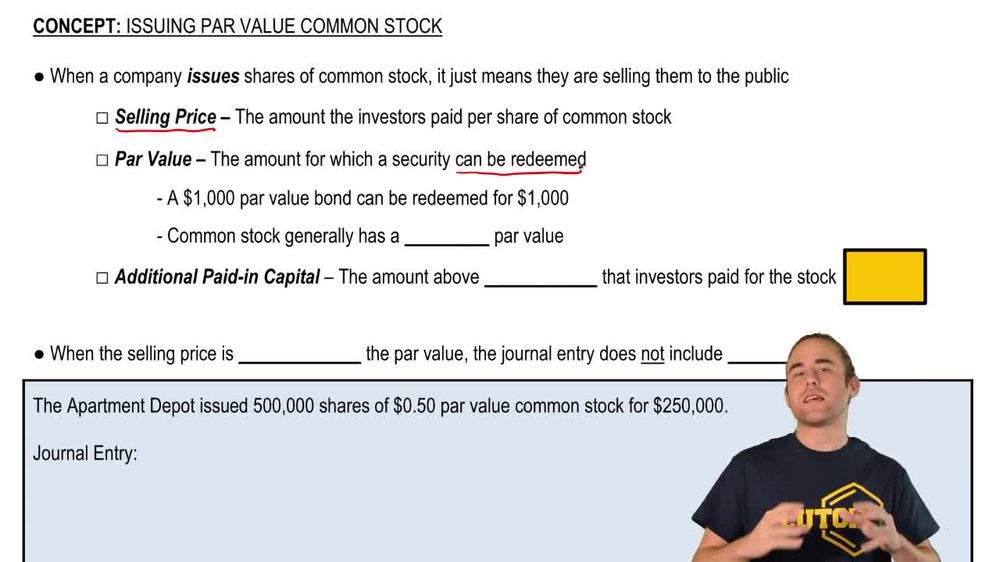
Par value is a nominal amount assigned to each share, usually less than \$1, and is recorded in the common stock account.
Where is the amount received above par value recorded when issuing stock?
The amount received above par value is recorded in the Additional Paid-In Capital (APIC) account.
What is the journal entry when stock is issued at par value?
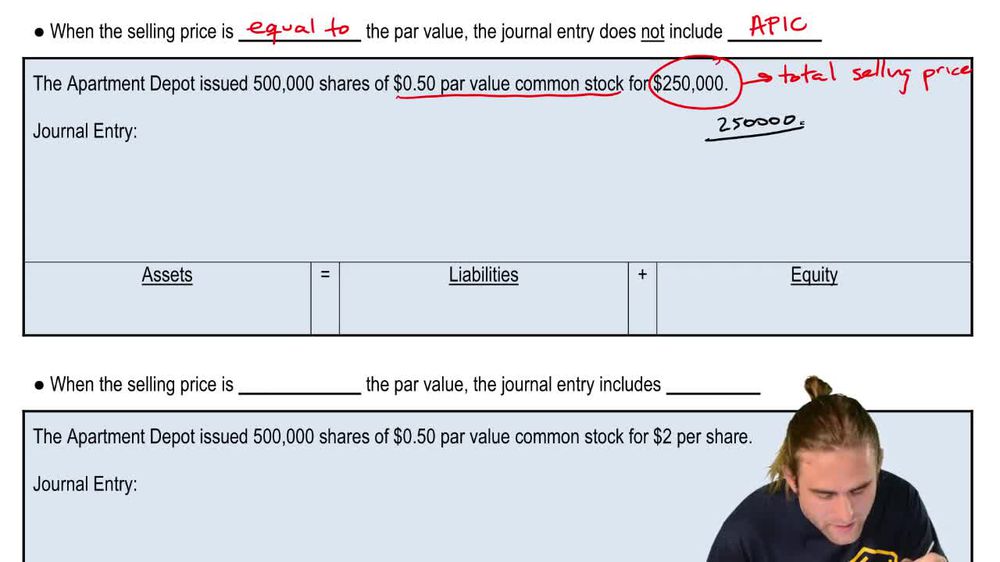
Debit cash for the amount received and credit common stock for the same amount; there is no APIC.
How do you calculate the amount to credit to the common stock account?
Multiply the number of shares issued by the par value per share.
If 500,000 shares with a par value of \$0.50 are sold for \$250,000, what is the APIC?
The APIC is \$0 because the shares were sold at par value.
What is the formula to find the per share selling price if given total proceeds and shares sold?
Divide the total selling price by the number of shares sold.
What is the typical journal entry format for issuing stock above par value?
Debit cash, credit common stock for the par value, and credit APIC for the excess over par.
If 500,000 shares with a par value of \$0.50 are sold for \$2 each, how much goes to APIC?
APIC receives \$750,000, which is the total cash received (\$1,000,000) minus the par value credited to common stock (\$250,000).
What does APIC stand for and what does it represent?
APIC stands for Additional Paid-In Capital and represents the amount investors paid above the par value.
Are both common stock and APIC equity accounts?
Yes, both common stock and APIC are equity accounts.
How do you calculate total cash received from a stock issuance?
Multiply the number of shares sold by the selling price per share.
What happens to the accounting equation when stock is issued for cash?
Assets (cash) increase and equity (common stock and possibly APIC) increases by the same amount.
What is another name for APIC that you might see in textbooks?
APIC may also be called 'Paid-in Capital in Excess of Par.'
Is it common to issue stock below par value?
No, it is very uncommon to issue stock below par value.
 BackBack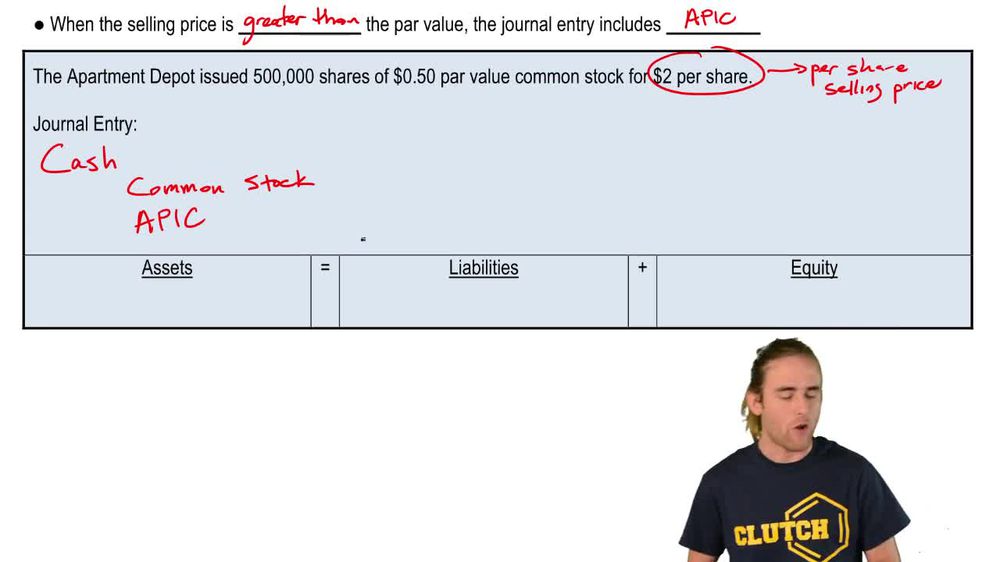
 05:26
05:26