Skip to main content
Financial Accounting
My Course
Learn
Exam Prep
AI Tutor
Study Guides
Flashcards
Explore
Try the app
My Course
Learn
Exam Prep
AI Tutor
Study Guides
Flashcards
Explore
Try the app
Back
Trial Balance definitions
You can tap to flip the card.
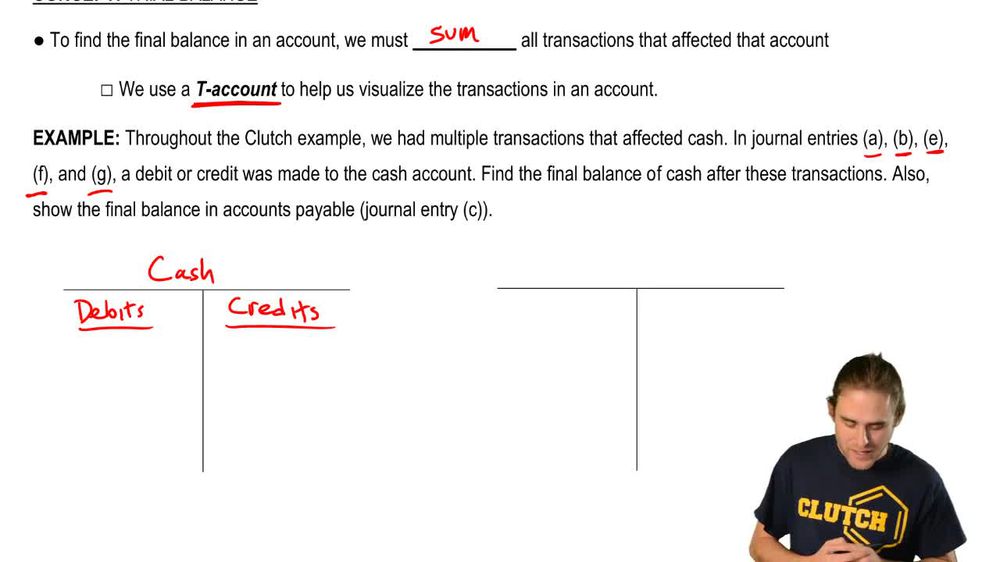
T Account
You can tap to flip the card.
👆
T Account
Visual tool shaped like a 'T' used to organize and summarize all debits and credits for a specific account.
Track progress
Control buttons has been changed to "navigation" mode.
1/15
Related flashcards
Related practice
Recommended videos
Trial Balance quiz #1
Trial Balance
34 Terms
Trial Balance
2. Transaction Analysis
10 problems
Topic
Classified Balance Sheet Components
2. Transaction Analysis
10 problems
Topic
2. Transaction Analysis
5 topics
15 problems
Chapter
Guided course
06:06
Constructing a Trial Balance
3147
views
142
rank
1
comments
Guided course
06:43
Using T-Accounts
4614
views
104
rank
Terms in this set (15)
Hide definitions
T Account
Visual tool shaped like a 'T' used to organize and summarize all debits and credits for a specific account.
Debit
Entry on the left side of a T account, typically increasing assets or expenses and decreasing liabilities or equity.
Credit
Entry on the right side of a T account, usually increasing liabilities, equity, or revenue and decreasing assets.
Trial Balance
List of all accounts and their final balances at a specific time, used to verify that total debits equal total credits.
Unadjusted Trial Balance
Initial listing of account balances before any adjusting entries, serving as a starting point for financial statement preparation.
Adjusted Trial Balance
Updated list of account balances after adjusting entries, ensuring accuracy before preparing financial statements.
Asset
Resource owned by a business, such as cash, supplies, or land, expected to provide future economic benefit.
Liability
Obligation or debt owed by a business to outsiders, such as accounts payable, requiring future payment.
Equity
Owner's residual interest in the business after liabilities are subtracted from assets.
Revenue
Income earned from normal business operations, increasing equity through sales or services provided.
Expense
Cost incurred in the process of earning revenue, reducing equity in the business.
Common Stock
Form of equity representing ownership shares issued to investors in exchange for capital.
Dividends
Distributions of earnings to shareholders, reducing retained earnings and overall equity.
Accounts Payable
Short-term liability representing amounts owed to suppliers for goods or services received on credit.
Accounts Receivable
Asset representing amounts owed to the business by customers for goods or services delivered on credit.
 BackBack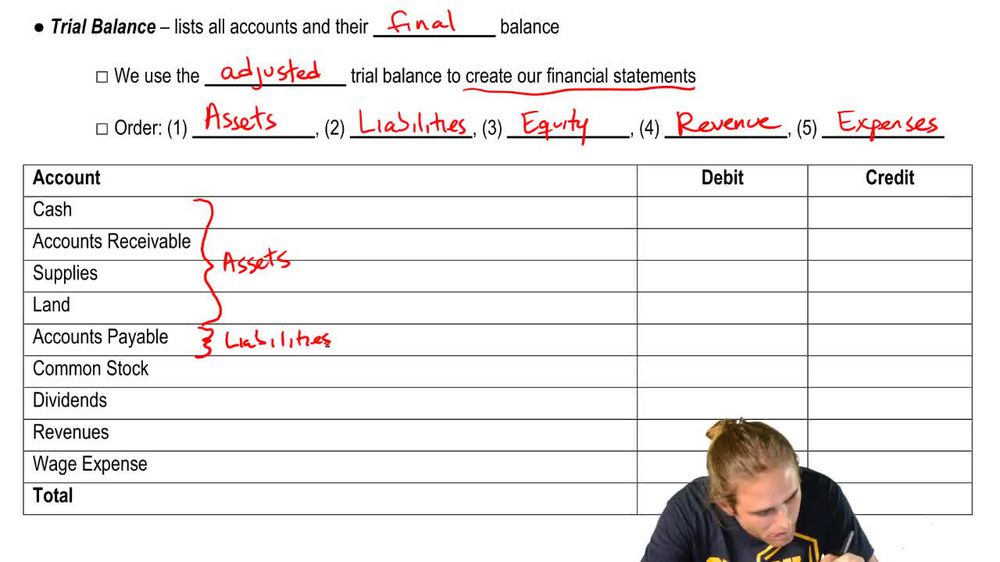
 06:06
06:06