Which outer electron configurations would you expect to belong to a noble gas? a. ns2 b. ns2np6 c. ns2np5 d. ns2np2
Ch.8 - Periodic Properties of the Elements
Chapter 8, Problem 51a,c,d
Determine the number of valence electrons in an atom of each element. a. Ba c. Ni d. S
Verified step by step guidance1
To determine the number of valence electrons, first identify the group number of the element in the periodic table.
For barium (Ba), locate it in Group 2 of the periodic table, which means it has 2 valence electrons.
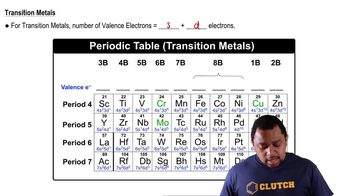
For nickel (Ni), locate it in the transition metals section. Transition metals can have varying valence electrons, but typically, Ni has 2 valence electrons in its outermost shell.
For sulfur (S), locate it in Group 16 of the periodic table, which means it has 6 valence electrons.
Remember that the group number for main group elements (s and p blocks) often indicates the number of valence electrons.
Key Concepts
Here are the essential concepts you must grasp in order to answer the question correctly.
Valence Electrons
Valence electrons are the outermost electrons of an atom and are crucial for determining how an element will react chemically. They are involved in forming bonds with other atoms, influencing the element's reactivity and the types of compounds it can form. The number of valence electrons can often be determined by an element's position in the periodic table.
Recommended video:
Guided course
Transition Metals Valence Electrons
Periodic Table
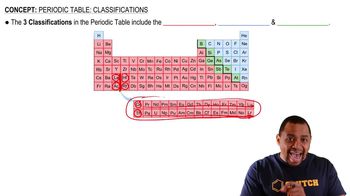
The periodic table organizes elements based on their atomic number and electron configuration, which helps predict their chemical properties. Elements in the same group (column) typically have the same number of valence electrons, leading to similar chemical behavior. Understanding the layout of the periodic table is essential for identifying the number of valence electrons in various elements.
Recommended video:
Guided course
Periodic Table Classifications
Electron Configuration
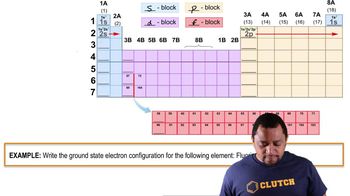
Electron configuration describes the distribution of electrons in an atom's orbitals. It provides insight into the number of valence electrons by indicating how many electrons occupy the outermost shell. For example, the electron configuration can be used to determine that elements like sulfur (S) have six valence electrons, while barium (Ba) has two.
Recommended video:
Guided course
Electron Configuration Example
Related Practice
Textbook Question
975
views
Textbook Question
Name an element in the third period (row) of the periodic table with the following: c. six 3p electrons
803
views

Textbook Question
Name an element in the fourth period (row) of the periodic table with the following: d. full s and p sublevels
1518
views
Textbook Question
Name an element in the third period (row) of the periodic table with the following: a. three valence electrons
852
views
Textbook Question
Which outer electron configuration would you expect to belong to a reactive nonmetal? a. ns2 b. ns2np6 c. ns2np5 d. ns2np2
2448
views
Textbook Question
Determine the number of valence electrons in each element. Which elements do you expect to lose electrons in chemical reactions? Which do you expect to gain electrons? a. Al b. Sn c. Br d. Se
966
views