
Ch.20 - Nuclear Chemistry
McMurry - Chemistry 8th Edition
McMurry8th EditionChemistryISBN: 9781292336145Not the one you use?Change textbook
Chapter 20, Problem 4

Fluorine-18 undergoes positron emission with a half-life of 1.10 x 10^2 minutes. If a patient is given a 250 mg dose for a PET scan, how long will it take for the amount of fluorine-18 to drop to 75 mg? (a) 56 minutes (b) 96 minutes (c) 132 minutes (d) 191 minutes

Verified step by step guidance
1
Identify the initial amount of fluorine-18, which is 250 mg, and the final amount, which is 75 mg.
Use the half-life formula for radioactive decay: \( N = N_0 \times (\frac{1}{2})^{\frac{t}{t_{1/2}}} \), where \( N \) is the final amount, \( N_0 \) is the initial amount, \( t \) is the time, and \( t_{1/2} \) is the half-life.
Substitute the known values into the formula: \( 75 = 250 \times (\frac{1}{2})^{\frac{t}{110}} \).
Solve for \( t \) by first dividing both sides by 250 to isolate the exponential term: \( \frac{75}{250} = (\frac{1}{2})^{\frac{t}{110}} \).
Take the natural logarithm of both sides to solve for \( t \): \( \ln(\frac{75}{250}) = \frac{t}{110} \times \ln(\frac{1}{2}) \), and then solve for \( t \).

Verified video answer for a similar problem:

This video solution was recommended by our tutors as helpful for the problem above.
Video duration:
5m

Key Concepts

Here are the essential concepts you must grasp in order to answer the question correctly.

Half-life

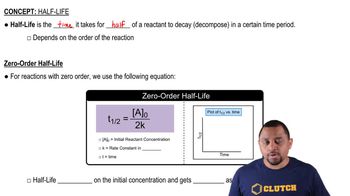
Half-life is the time required for half of a sample of a radioactive substance to decay. In this context, Fluorine-18 has a half-life of 110 minutes, meaning that after this time, only half of the original amount remains. Understanding half-life is crucial for calculating how long it takes for a specific quantity of a radioactive isotope to decrease to a desired level.
Recommended video:
02:17
Zero-Order Half-life

Exponential decay

Exponential decay describes the process by which a quantity decreases at a rate proportional to its current value. For radioactive substances like Fluorine-18, the amount remaining after a certain time can be calculated using the formula N(t) = N0 * (1/2)^(t/T), where N0 is the initial amount, T is the half-life, and t is the elapsed time. This concept is essential for determining how long it takes for the amount of Fluorine-18 to drop from 250 mg to 75 mg.
Recommended video:
03:01
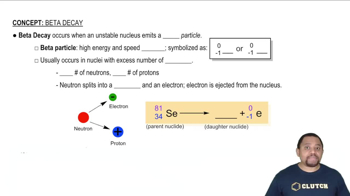
Beta Decay

Radioactive decay equations

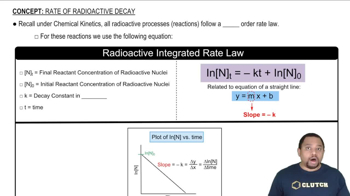
Radioactive decay equations are mathematical expressions used to model the decay of radioactive isotopes over time. These equations allow us to predict the remaining quantity of a substance after a given time period. In this problem, applying the decay equation will help calculate the time required for the Fluorine-18 dose to decrease from 250 mg to 75 mg, which is a key step in solving the question.
Recommended video:
03:00
Rate of Radioactive Decay