Ch.21 - Transition Elements and Coordination Chemistry
McMurry - Chemistry 8th Edition
McMurry8th EditionChemistryISBN: 9781292336145Not the one you use?Change textbook
Chapter 21, Problem 21.38b

Predict the number of unpaired electrons for each of the following.
(c) Mn3+
(d) Cr2+

Verified step by step guidance
1
Step 1: Determine the electron configuration of the neutral atom. For Mn (Manganese), the electron configuration is [Ar] 4s2 3d5. For Cr (Chromium), the electron configuration is [Ar] 4s1 3d5.
Step 2: Remove electrons to account for the positive charge. For Mn3+, remove three electrons. The first two electrons are removed from the 4s orbital, and the third electron is removed from the 3d orbital, resulting in the electron configuration [Ar] 3d4. For Cr2+, remove two electrons. The first electron is removed from the 4s orbital, and the second electron is removed from the 3d orbital, resulting in the electron configuration [Ar] 3d4.
Step 3: Determine the number of unpaired electrons by looking at the electron configuration. For Mn3+, there are four unpaired electrons in the 3d orbital. For Cr2+, there are also four unpaired electrons in the 3d orbital.
Step 4: Remember that unpaired electrons are responsible for the magnetic properties of an atom or ion. The more unpaired electrons, the stronger the magnetic properties.
Step 5: Practice predicting the number of unpaired electrons for different atoms and ions to become more comfortable with this process.

Verified video answer for a similar problem:

This video solution was recommended by our tutors as helpful for the problem above.
Video duration:
3m
Was this helpful?

Key Concepts

Here are the essential concepts you must grasp in order to answer the question correctly.

Electron Configuration

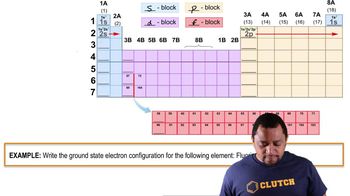
Electron configuration describes the distribution of electrons in an atom's orbitals. For transition metals, this involves filling the 3d and 4s orbitals according to the Aufbau principle, Hund's rule, and the Pauli exclusion principle. Understanding the electron configuration of an element is crucial for predicting its chemical properties, including the number of unpaired electrons.
Recommended video:
Guided course
01:33
Electron Configuration Example

Unpaired Electrons

Unpaired electrons are electrons that occupy an orbital alone rather than in pairs. The presence of unpaired electrons in an atom contributes to its magnetic properties and reactivity. In transition metals, the number of unpaired electrons can be determined by examining the electron configuration and identifying how many electrons are in the d orbitals without a partner.
Recommended video:
Guided course
04:44
Electron Geometry

Oxidation States

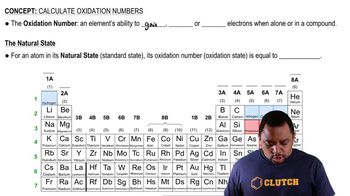
Oxidation states indicate the degree of oxidation of an atom in a compound, reflecting the number of electrons lost or gained. For transition metals, oxidation states can affect the electron configuration significantly. For example, Mn in Mn3+ has lost three electrons, which alters its electron configuration and the number of unpaired electrons compared to its neutral state.
Recommended video:
Guided course
02:42
Oxidation Numbers
Related Practice
Textbook Question

What is the systematic name for each of the following ions? 

(c) [Co(CO3)3]3-

(d) [Pt(en)2(SCN)2]2+

117
views

Textbook Question

For each of the following complexes, describe the bonding using valence bond theory. Include orbital diagrams for the free metal ion and the metal ion in the complex. Indicate which hybrid orbitals the metal ion uses for bonding, and specify the number of unpaired electrons. 

(b) [Ag(NH3)2]+

128
views
Textbook Question

Cobalt(III) trifluoroacetylacetonate, Co(tfac)3, is a sixcoordinate, octahedral metal chelate in which three planar, bidentate tfac ligands are attached to a central Co atom:

(b) Diastereoisomers A and B have dipole moments of 6.5 D and 3.8 D, respectively. Which of your diastereoisomers is A and which is B?

108
views
Textbook Question

Give a valence bond description of the bonding in each of the following complexes. Include orbital diagrams for the free metal ion and the metal ion in the complex. Indicate which hybrid orbitals the metal ion uses for bonding, and specify the number of unpaired electrons. 

(b) [NiBr4]2- (tetrahedral) 

112
views
Textbook Question

Nickel(II) complexes with the formula NiX2L2, where X is Cl- or N-bonded NCS- and L is the monodentate triphenylphosphine ligand P(C6H5)3, can be square planar or tetrahedral.

(b) If NiCl2L2 is paramagnetic and Ni(NCS)2L2 is diamagnetic, which of the two complexes is tetrahedral and which is square planar?

108
views
Textbook Question

Look at the location in the periodic table of elements A, B, C, and D. What is the electron configuration of the transition metal in each of the following ions?  

(a) A2+

(b) B+

108
views