Ch.21 - Transition Elements and Coordination Chemistry
McMurry - Chemistry 8th Edition
McMurry8th EditionChemistryISBN: 9781292336145Not the one you use?Change textbook
Chapter 21, Problem 21.10

What hybrid orbitals are used by the metal ion and how many unpaired electrons are present the complex ion [VCl4]- with tetrahedral geometry?
(a) sp3; 2 unpaired electrons
(b) sp3; 3 unpaired electrons
(c) sp3d2; 3 unpaired electrons
(d) sp3d2; 4 unpaired electrons

Verified step by step guidance
1
Identify the central metal ion in the complex. Here, it is vanadium (V).
Determine the oxidation state of vanadium in the complex [VCl_4]^-. Chlorine (Cl) has a -1 charge, and there are four Cl^- ions, so the total charge from Cl is -4. The complex has an overall charge of -1, so the oxidation state of V is +3.
Write the electron configuration for the V^3+ ion. Vanadium (V) has an atomic number of 23, so its electron configuration is [Ar] 3d^3 4s^2. For V^3+, remove three electrons, resulting in [Ar] 3d^2.
Determine the hybridization of the metal ion. Since the complex has a tetrahedral geometry, the hybridization is sp^3.
Count the number of unpaired electrons in the 3d orbitals of V^3+. With the electron configuration [Ar] 3d^2, there are 2 unpaired electrons.

Verified video answer for a similar problem:

This video solution was recommended by our tutors as helpful for the problem above.
Was this helpful?

Key Concepts

Here are the essential concepts you must grasp in order to answer the question correctly.

Hybridization

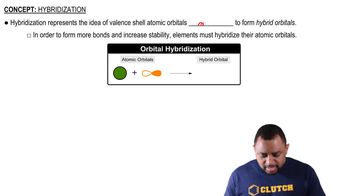
Hybridization is the concept of mixing atomic orbitals to form new hybrid orbitals that can accommodate bonding in molecules. In the case of transition metals, the hybridization can involve s, p, and d orbitals, depending on the coordination number and geometry of the complex. For tetrahedral complexes, the common hybridization is sp³, which involves one s and three p orbitals.
Recommended video:
Guided course
00:51
Hybridization

Tetrahedral Geometry

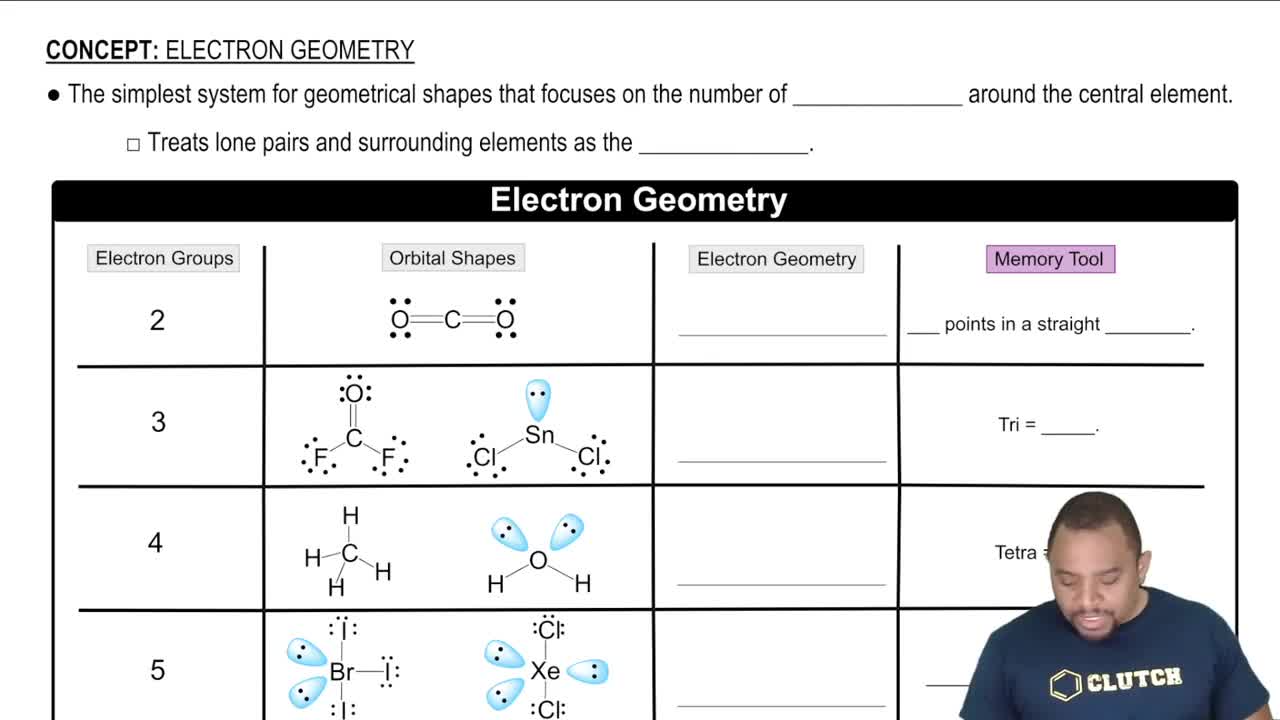
Tetrahedral geometry occurs when a central atom is surrounded by four substituents arranged at the corners of a tetrahedron. This geometry is characterized by bond angles of approximately 109.5 degrees. In coordination complexes, tetrahedral geometry typically arises when a metal ion is bonded to four ligands, influencing the hybridization of the metal's orbitals.
Recommended video:
Guided course
04:44
Electron Geometry

Unpaired Electrons

Unpaired electrons are electrons in an atom or ion that are not paired with another electron in an orbital. The presence of unpaired electrons is crucial for determining the magnetic properties of a substance and can influence the color and reactivity of coordination complexes. In transition metal complexes, the number of unpaired electrons can be determined by the electron configuration of the metal ion and its hybridization state.
Recommended video:
Guided course
04:44
Electron Geometry
Related Practice
Textbook Question

What is the highest oxidation state for each of the elements from Sc to Zn?

101
views

Textbook Question

What is a racemic mixture? Does it affect plane-polarized light? Explain.

87
views
Textbook Question

The amount of paramagnetism for a first-series transition metal complex is related approximately to its spin-only magnetic moment. The spin-only value of the magnetic moment in units of Bohr magnetons (BM) is given by sqrt(n(n + 2)), where n is the number of unpaired electrons. Calculate the spin-only value of the magnetic moment for the 2+ ions of the first-series transition metals (except Sc) in octahedral complexes with (a) weak-field ligands and (b) strong-field ligands. For which electron configurations can the magnetic moment distinguish between high-spin and low-spin electron configurations?

99
views
Textbook Question

What is the oxidation state of the metal in each of the complexes?

a. [Ni(CN)5]3–

b. Ni(CO)4

c. [Co(en)2(H2O)Br]2+

d. [Cu(H2O)2(C2O4)2]2–

e. Co(NH3)3(NO2)3

72
views
Textbook Question

Based on the wavelength of maximum absorption of the cobalt complexes, arrange the following ligands in a spectrochemical series from weakest-field to strongest-field ligand. 

(a) Cl- < NCS- < H2O < NH3 

(b) Cl- < NCS- < H2O < NH3 

(c) H2O < Cl- < NH3 < NCS-

(d) Cl- < H2O < NCS- < NH3

105
views
Textbook Question

Which of the following complexes can exist as enantiomers? Draw their structures.

(a) [Cr(en)3]3+

(b) cis-[Co(NH3)Cl]2+

(c) trans-[Co(en)2(NH3)Cl]2+

(d) [Pt(NH3)3Cl3]+

112
views