Van der Waals Equation
- Download the worksheet to save time writing
- Start solving the practice problems
- If you're stuck, watch the video solutions
- See your summary to get more insights

Van der Waals Equation
5 problems
Problem 2Multiple Choice
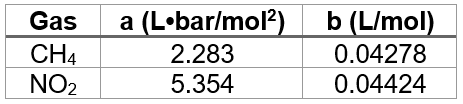
The following table shows the values of the van der Waals constants a and b for CH4 and NO2. Which of the two gases is expected to be close to the ideal behavior at low temperatures?
Problem 5Multiple Choice
For 1-mol sample of gas in a 1-L container, the graph for the change in pressure as the temperature increases is shown below. The four plots represent an ideal gas and three real gases: sulfur dioxide (SO2), argon (Ar), and ammonia (NH3).

Given the van der Waals constants below, assign the gases (SO2, Ar, NH3) to their corresponding plots (A, B, C).
