Atomic Theory definitions Flashcards
Atomic Theory definitions
You can tap to flip the card.
Control buttons has been changed to "navigation" mode.
1/15
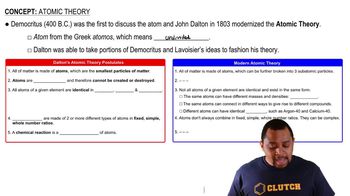
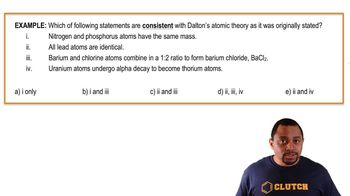
Atomic TheoryA scientific theory that matter is composed of discrete units called atoms.AtomThe smallest unit of matter that retains the identity of a chemical element.IsotopeAtoms of the same element with the same atomic number but different mass numbers.Subatomic ParticlesParticles that are smaller than an atom, including protons, neutrons, and electrons.Conservation of MassA principle stating that mass cannot be created or destroyed in a chemical reaction.ElementA substance consisting of atoms which all have the same number of protons.CompoundA substance formed when two or more chemical elements are chemically bonded together.Mass NumberThe total number of protons and neutrons in an atomic nucleus.Chemical ReactionA process that involves rearrangement of the molecular or ionic structure of a substance.ProtonA subatomic particle found in the nucleus of every atom, carrying a positive charge.NeutronA subatomic particle found in the nucleus of atoms, having no electric charge.ElectronA subatomic particle with a negative charge, found in all atoms and acting as the primary carrier of electricity.Molecular StructureThe arrangement of atoms within a molecule.CarbonA chemical element with symbol C and atomic number 6, known for its various allotropes.Dalton's PostulatesA set of principles proposed by John Dalton to describe the nature of atoms and matter.