Atomic Theory quiz #1 Flashcards

Atomic Theory quiz #1
Control buttons has been changed to "navigation" mode.
1/40
  • Which is a component of John Dalton’s atomic theory?
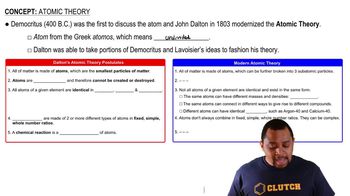
    All matter is composed of indivisible atoms that cannot be created or destroyed.
  • Which is not one of Dalton's hypotheses of atomic theory?
    Atoms can be divided into smaller particles during chemical reactions.
  • Which statement is part of Dalton's atomic theory?
    Atoms of different elements combine in fixed, simple whole number ratios to form compounds.
  • Which was a benefit that chemists derived from Dalton's atomic theory?
    It provided a systematic explanation for the conservation of mass in chemical reactions.
  • When did Dalton form his atomic theory?
    Dalton formulated his atomic theory in 1803.
  • Dalton's atomic theory included which idea?
    Atoms of a given element are identical in mass and properties.
  • What is the name of John Dalton’s theory?
    Dalton's Atomic Theory.
  • What is the difference between a law and a theory in chemistry?
    A law describes observed phenomena, while a theory explains the underlying reasons for those phenomena.
  • What are the four main components of Dalton’s atomic theory?
    1) Matter is made of atoms; 2) Atoms are indivisible and indestructible; 3) Atoms of the same element are identical; 4) Compounds are formed by atoms in fixed ratios.
  • Which cannot be chemically broken down into simpler substances?
    An element.
  • Which model most accurately represents the current view of the structure of the atom?
    The quantum mechanical model.
  • Which statements are part of Dalton's atomic theory?
    Atoms are indivisible, and chemical reactions involve the rearrangement of atoms.
  • What aspect of the classical mechanical description of the atom is flawed?
    It does not account for subatomic particles or the existence of isotopes.
  • Which of the following reactions is possible according to Dalton's atomic theory?
    Atoms rearrange during chemical reactions, but are not created or destroyed.
  • Which statement is one of the postulates in Dalton's atomic theory?
    Atoms of different elements have different masses and properties.
  • What is Dalton's atomic theory?
    A theory stating that matter is composed of indivisible atoms, which combine in fixed ratios to form compounds.
  • Who developed the atomic theory of matter?
    John Dalton.
  • In the plum pudding model of the atom, what is the structure of the atom?
    Electrons are embedded in a positively charged 'pudding' or matrix.
  • Which statement below is also true of the rearrangement of atoms?
    Chemical reactions involve only the rearrangement of atoms, not their creation or destruction.
  • What is J.J. Thomson's model called?
    The plum pudding model.
  • Which are covalent network solids formed from carbon?
    Diamond and graphite.
  • Which model of the atom was used as a result of J.J. Thomson's cathode ray experiments?
    The plum pudding model.
  • When was Avogadro's theory finally accepted?
    Avogadro's theory was widely accepted in the mid-19th century, decades after its proposal.
  • Which of the following is an atomic element?
    Helium.
  • Which statement is not part of Dalton's atomic theory?
    Atoms can be transformed into atoms of other elements during chemical reactions.
  • Which atomic model was proposed as a result of J. J. Thomson’s work?
    The plum pudding model.
  • Dalton concluded that compounds are made up of what?
    Compounds are made up of atoms of different elements combined in fixed ratios.
  • What did Dalton's theory say about atoms?
    Atoms are indivisible, indestructible, and combine in fixed ratios to form compounds.
  • Who was the first to propose the existence of atoms?
    Democritus.
  • Which of the following was a major contribution to chemistry by Antoine Lavoisier?
    The law of conservation of mass.
  • Which is one postulate in Dalton’s atomic theory?
    Atoms of a given element are identical in mass and properties.
  • According to Dalton's postulates, what happens during a chemical reaction?
    Atoms are rearranged, but not created or destroyed.
  • Which of the following is one component of John Dalton’s atomic theory?
    Compounds are formed by atoms of different elements in fixed ratios.
  • What experimental evidence led to the development of this atomic model from the one before it?
    J.J. Thomson's cathode ray experiments showed the existence of electrons, leading to the plum pudding model.
  • Which statement belongs to Dalton’s atomic theory?
    Atoms of different elements have different masses and properties.
  • What new characteristic did John Dalton add to the model of the atom?
    He proposed that atoms of each element are identical and combine in fixed ratios to form compounds.
  • Which best explains how scientists confirmed that the moon formed around the same time as Earth?
    By analyzing isotopic ratios, similar to how chemists study isotopes in atomic theory.
  • Which scientist is known for developing the planetary model of the atom?
    Niels Bohr.
  • Which scientist is credited with developing the first scientific atomic theory?
    John Dalton.
  • What is alchemy?
    Alchemy is an ancient practice that aimed to transform matter, often considered a precursor to modern chemistry.