Control buttons has been changed to "navigation" mode.
1/10
Terms in this set (10)
What is the bond order of the H–Ar and Ar–F bonds?
Both H–Ar and Ar–F bonds are rare or hypothetical, but if they exist as single bonds, their bond order would be 1.
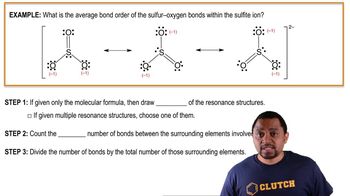
What is the bond order for the nitrogen-oxygen (N–O) bond in NO2– (nitrite ion)?
The bond order for each N–O bond in NO2– is 1.5, calculated as the average between one single and one double bond due to resonance.
Which bond is the longest among single, double, and triple bonds?
The single bond is the longest because bond length is inversely proportional to bond order.
What is the expected bond order for the diatomic species B2?
The bond order for B2 is 1, indicating a single bond between the two boron atoms.
What is the bond order of the polyatomic molecule CN– (cyanide ion)?
The bond order of CN– is 3, corresponding to a triple bond between carbon and nitrogen.
What is the bond order of the O–O bond in O2?
The bond order of the O–O bond in O2 is 2, indicating a double bond.
What is the bond order of a diatomic molecule that has 14 valence electrons?
A diatomic molecule with 14 valence electrons, such as N2, has a bond order of 3.
What would be the bond order of the hypothetical molecule Ar2?
The bond order of Ar2 is 0, indicating no bond forms between two argon atoms.
What is the bond order of each carbon–oxygen bond in the carbonate ion (CO3^2–)?
Each C–O bond in CO3^2– has a bond order of 1.33, due to resonance among three equivalent bonds.
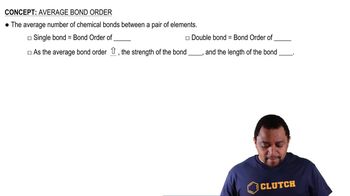
How does increasing average bond order affect the physical properties of a chemical bond?
Increasing average bond order makes the bond stronger and shorter, due to direct proportionality with strength and inverse proportionality with length.