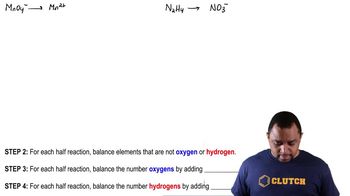
Describe the steps required to balance a redox reaction occurring in basic solution.
To balance a redox reaction in basic solution, first balance the reaction as if it were in acidic solution: split into half-reactions, balance atoms other than H and O, balance O using H2O, balance H using H+, and balance charge using electrons. Then, for basic solution, add one extra step: neutralize any H+ by adding an equal number of OH- ions to both sides of the equation. Combine H+ and OH- to form H2O, and simplify if possible. Ensure the final equation is balanced for both mass and charge.
Why is it important to master balancing redox reactions in acidic solutions before attempting them in basic solutions?
Balancing in basic solutions builds directly on the steps used for acidic solutions, with only one additional step required. Mastery of the acidic process ensures you understand the foundation needed for the basic solution method.
What ion is typically present in basic redox reactions that requires special attention during balancing?
The hydroxide ion (OH-) is typically present in basic redox reactions and must be accounted for during the balancing process.
What is the additional step required when balancing redox reactions in basic solutions compared to acidic solutions?
After balancing as in acidic conditions, you must add OH- ions to neutralize any H+ ions, forming water and ensuring the reaction is balanced for a basic medium.
How does the presence of OH- ions affect the balancing of redox reactions in basic solutions?
OH- ions require you to neutralize H+ ions formed during balancing, which changes the final composition of the balanced equation compared to acidic conditions.
What should you do if you encounter H+ ions in your balanced redox equation for a basic solution?
You should add an equal number of OH- ions to both sides to neutralize the H+ ions, forming water molecules.
What law must be satisfied when balancing redox reactions in basic solutions?
The law of conservation of mass and charge must be satisfied in the final balanced equation.
Why is the final step in balancing redox reactions in basic solutions considered essential?
It ensures the chemical changes are accurately represented for a basic medium, reflecting the correct species present and maintaining balance.
What should you do after forming water by combining H+ and OH- ions in a basic redox reaction?
You should simplify the equation by canceling out any water molecules that appear on both sides of the reaction.
What is the recommended prerequisite before learning to balance redox reactions in basic solutions?
It is recommended to first learn and master balancing redox reactions in acidic solutions.