Beta Decay definitions Flashcards
You can tap to flip the card.
Control buttons has been changed to "navigation" mode.
1/14
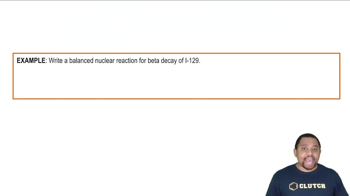
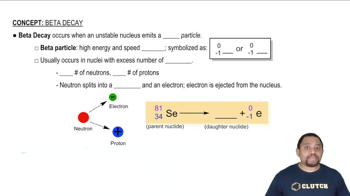
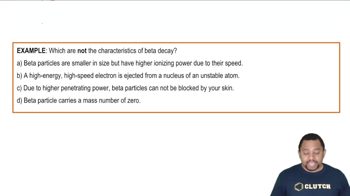
Beta DecayA nuclear process where an unstable nucleus emits a high-speed electron to convert a neutron into a proton.Beta ParticleA high-energy, high-speed electron emitted during beta decay, with negligible mass and negative charge.NeutronA subatomic particle in the nucleus with no charge, which can convert into a proton and electron during beta decay.ProtonA positively charged subatomic particle in the nucleus, increased in number during beta decay.ElectronA negatively charged subatomic particle ejected from the nucleus during beta decay.Selenium-81An isotope that undergoes beta decay to transform into bromine-81, maintaining a mass number of 81.Bromine-81The product of selenium-81 after beta decay, with an increased atomic number but unchanged mass number.Mass NumberThe total number of protons and neutrons in a nucleus, unchanged during beta decay.Atomic NumberThe number of protons in a nucleus, increased by one during beta decay.Ionizing PowerThe ability of a particle to ionize atoms, lower for beta particles compared to alpha particles.Penetrating PowerThe ability of a particle to pass through materials, higher for beta particles than alpha particles.Alpha ParticleA larger particle compared to beta particles, with higher ionizing but lower penetrating power.Helium-4An isotope representing alpha particles, consisting of two protons and two neutrons.ShieldingThe use of dense materials like metal or wood to block beta particles due to their penetrating power.