Bohr Model definitions Flashcards

Bohr Model definitions
Control buttons has been changed to "navigation" mode.
1/15
  • Bohr Model
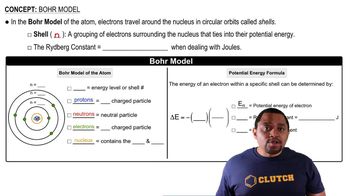
    A model where electrons orbit the nucleus in defined paths called shells, each with a specific energy level.
  • Shell
    A grouping of electrons surrounding the nucleus, associated with a specific energy level denoted by n.
  • Principal Quantum Number
    Denoted by n, it represents the shell number and energy level of an electron in an atom.
  • Rydberg Constant
    A constant used in calculating the potential energy of an electron in a shell, valued at 2.178 x 10^-18 J.
  • Atomic Number
    The number of protons in the nucleus of an atom, denoted by Z.
  • Potential Energy
    The energy of position for an electron in a shell, calculated using the Rydberg formula.
  • Absorption
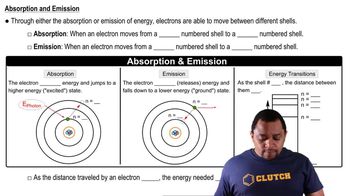
    The process where an electron moves to a higher energy shell by absorbing energy.
  • Emission
    The process where an electron releases energy and moves to a lower energy shell.
  • Ground State
    The lowest energy state of an electron in an atom, typically the original shell.
  • Excited State
    A higher energy state of an electron after absorbing energy and moving to a higher shell.
  • Energy Transition
    The movement of an electron between shells, requiring energy proportional to the distance.
  • Photon
    A particle representing a quantum of light, which can transfer energy to electrons.
  • Orbit
    The path followed by electrons around the nucleus in the Bohr model.
  • Proton
    A positively charged particle found in the nucleus of an atom.
  • Neutron
    A neutrally charged particle found in the nucleus of an atom.