Back

Intermolecular Forces and Physical Properties quiz

Control buttons has been changed to "navigation" mode.
1/15
  • What are intermolecular forces?

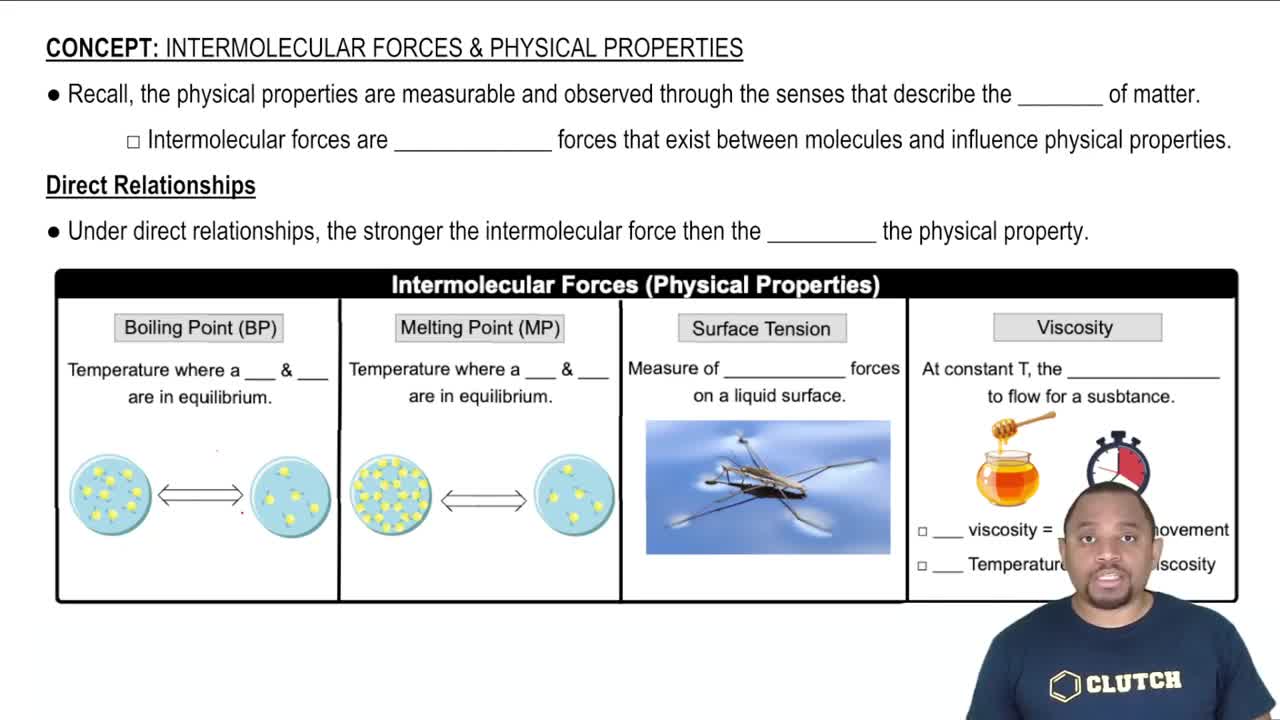
    Intermolecular forces are attractive forces that exist between molecules and influence physical properties.
  • How do intermolecular forces affect boiling point?

    Stronger intermolecular forces lead to a higher boiling point because more energy is needed to separate the molecules.
  • What is boiling point?

    Boiling point is the temperature at which a liquid and gas are in equilibrium, allowing vaporization and condensation to occur.
  • How do intermolecular forces affect melting point?

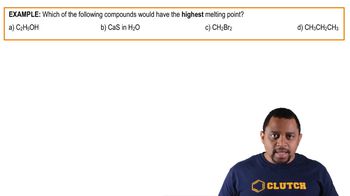
    Stronger intermolecular forces result in a higher melting point, as more energy is required to change a solid into a liquid.
  • What is melting point?

    Melting point is the temperature at which a solid and liquid are in equilibrium, allowing melting and freezing to occur.
  • What is surface tension?

    Surface tension is a measure of the attractive forces at a liquid's surface, caused by cohesive intermolecular forces.
  • How do intermolecular forces affect surface tension?

    Stronger intermolecular forces increase surface tension, making the liquid's surface more cohesive.
  • Why can insects walk on water?

    Insects can walk on water because strong intermolecular forces create high surface tension, forming a cohesive surface.
  • What is viscosity?

    Viscosity is the resistance to flow in a substance, with higher viscosity meaning slower movement.
  • How do intermolecular forces affect viscosity?

    Stronger intermolecular forces increase viscosity, making the substance flow more slowly.
  • How can viscosity be reduced?

    Viscosity can be reduced by increasing the temperature, which allows molecules to move more freely.
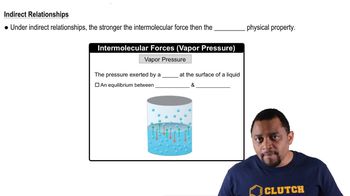
  • What is vapor pressure?

    Vapor pressure is the pressure exerted by a gas at the surface of a liquid, resulting from equilibrium between condensation and vaporization.
  • How do intermolecular forces affect vapor pressure?

    Stronger intermolecular forces lead to lower vapor pressure because molecules are less likely to escape into the gas phase.
  • What is the relationship between intermolecular forces and vapor pressure?

    Intermolecular forces and vapor pressure are inversely related; as intermolecular forces increase, vapor pressure decreases.
  • What happens to viscosity when temperature increases?

    When temperature increases, viscosity decreases, allowing the substance to flow more easily.