Calculate Oxidation Numbers definitions Flashcards
Calculate Oxidation Numbers definitions
You can tap to flip the card.
Control buttons has been changed to "navigation" mode.
1/15
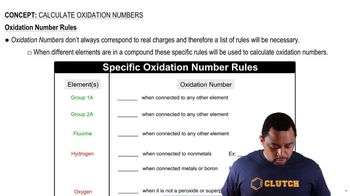
Oxidation NumberIndicates an element's ability to gain, lose, or share electrons in its elemental or compound form.Redox ReactionsChemical reactions involving the transfer of electrons between two species, encompassing oxidation and reduction processes.Standard StateThe natural form of an element where its oxidation number is zero.Diatomic MoleculesMolecules composed of two atoms, such as H2, N2, O2, F2, Cl2, Br2, and I2, with an oxidation number of zero.CationsPositively charged ions formed when an element loses electrons.AnionsNegatively charged ions formed when an element gains electrons.Monoatomic IonAn ion consisting of a single atom with an oxidation number equal to its charge.PeroxideA compound with two oxygen atoms bonded together, typically with an oxidation number of -1 for oxygen.SuperoxideA compound with one oxygen atom bonded to a group 1A element, with an oxidation number of -1/2 for oxygen.Group 1A ElementsElements with an oxidation number of +1 when bonded to other elements.Group 2A ElementsElements with an oxidation number of +2 when bonded to other elements.Group 7A ElementsElements like chlorine, bromine, and iodine with an oxidation number of -1, except when bonded to oxygen.HydrogenHas an oxidation number of +1 when bonded to nonmetals and -1 when bonded to metals.OxygenTypically has an oxidation number of -2, except in peroxides and superoxides.Noble GasesElements that typically have no charge due to their stable electron configuration.