Cell Notation definitions Flashcards

Cell Notation definitions
Control buttons has been changed to "navigation" mode.
1/15
  • Cell Notation
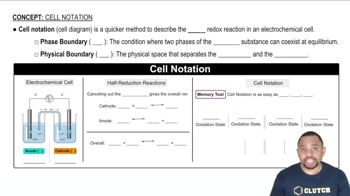
    A shorthand method to represent the redox reaction in an electrochemical cell using phase and physical boundaries.
  • Phase Boundary
    A single line in cell notation indicating where two phases of the same substance coexist at equilibrium.
  • Physical Boundary
    Two solid lines in cell notation representing the separation between the anode and cathode.
  • Anode
    The electrode where oxidation occurs, losing electrons, and is negatively charged in a galvanic cell.
  • Cathode
    The electrode where reduction occurs, gaining electrons, and is positively charged in a galvanic cell.
  • Oxidation
    A process at the anode where electrons are lost, resulting in an increase in oxidation state.
  • Reduction
    A process at the cathode where electrons are gained, resulting in a decrease in oxidation state.
  • Galvanic Cell
    A spontaneous electrochemical cell where chemical energy is converted into electrical energy.
  • Voltaic Cell
    Another term for a galvanic cell, where spontaneous redox reactions generate electricity.
  • Half-Reaction
    A part of the redox reaction showing either oxidation or reduction, used to balance the overall reaction.
  • Electrode
    A conductor through which electrons enter or leave the electrochemical cell, such as anode or cathode.
  • Cu 2+
    Copper ion with a 2+ charge, involved in reduction at the cathode in the given cell example.
  • Cr 2+
    Chromium ion with a 2+ charge, involved in oxidation at the anode in the given cell example.
  • Redox Reaction
    A chemical reaction involving the transfer of electrons between two species, comprising oxidation and reduction.
  • Intermediates
    Species that appear in the steps of a reaction mechanism but not in the overall balanced equation.