Back

Classification of Matter quiz #3

Control buttons has been changed to "navigation" mode.
1/40
  • Which kingdom belongs to the domain Eukarya?

    Plantae
  • What is an example of a nonrenewable resource?

    Coal
  • Which of these is a renewable resource? a. oil b. coal c. wind d. natural gas

    c. wind
  • What percentage of the Earth's water is salt water?

    Approximately 97% of the Earth's water is salt water.
  • What is not an example of an emergent property?

    The individual properties of water molecules are not an example of an emergent property.
  • What is plasma composed of?

    Plasma is composed of ions and free electrons.
  • Which biogeochemical cycle does not cycle through the atmosphere?

    Phosphorus cycle
  • Which option is a renewable resource? a. coal b. oil c. solar d. natural gas

    c. solar
  • What type of material slows the flow of heat and electricity?

    An insulator slows the flow of heat and electricity.
  • Which is not a macromolecule? a. protein b. lipid c. glucose d. nucleic acid

    c. glucose
  • Which gas is not a greenhouse gas?

    Nitrogen
  • Which gas is not considered a greenhouse gas?

    Oxygen
  • Which of these biological elements cannot be recycled? a. carbon b. nitrogen c. phosphorus d. energy

    d. energy
  • Which of these is not a greenhouse gas? a. nitrous oxide b. carbon dioxide c. ozone d. methane

    c. ozone
  • What is the correct order of classification?

    The correct order is Domain, Kingdom, Phylum, Class, Order, Family, Genus, Species.
  • What is a source of point pollution?

    Factory discharge
  • Which gas is not a main type of greenhouse gas?

    Oxygen
  • Which gas is not a greenhouse gas?

    Nitrogen
  • H2O (water) is what type of compound?

    H2O (water) is a compound composed of hydrogen and oxygen atoms chemically bonded together.
  • Which is the only nutrient to not cycle through the atmosphere?

    Phosphorus is the only nutrient that does not cycle through the atmosphere.
  • What is an example of a renewable resource?

    Wind
  • What process contributes to the mineral content of soils?

    Weathering of rocks contributes to the mineral content of soils.
  • How should this molecule be classified and why?

    This molecule should be classified as a compound because it consists of two or more different elements chemically bonded together.
  • What makes minerals inorganic nutrients?

    Minerals are considered inorganic nutrients because they are naturally occurring substances that do not contain carbon-hydrogen bonds.
  • What natural resource is considered renewable?

    Solar
  • Which is a correct association: starch is a type of what biomolecule?

    Carbohydrate
  • What is an example of applied science?

    Engineering is an example of applied science.
  • What is true about inorganic compounds?

    Inorganic compounds typically do not contain carbon-hydrogen bonds.
  • Which soil particles are the smallest?

    Clay particles are the smallest soil particles.
  • What percentage of Earth's water is salt water?

    Approximately 97% of Earth's water is salt water.
  • What is true of open systems?

    Open systems exchange both energy and matter with their surroundings.
  • Which kingdom does not contain any eukaryotes?

    The kingdom Bacteria does not contain any eukaryotes.
  • What is true about all molecules?

    All molecules are composed of two or more atoms chemically bonded together.
  • Which substance is a compound: water, gold, oxygen, hydrogen?

    Water is a compound.
  • What is an example of a heterogeneous mixture?

    A mixture like oil and water is heterogeneous.
  • Which heterogeneous mixture contains large particles that can settle out or can be filtered?

    A suspension contains large particles that can settle out or be filtered.
  • Which two types of matter are pure substances?

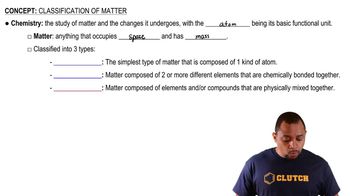
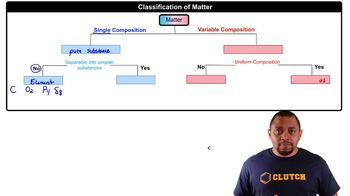
    Elements and compounds are pure substances.
  • Which substance is a mixture?

    A combination of two or more substances physically mixed, like air.
  • How is a compound different from an element?

    A compound is made of two or more different elements chemically bonded; an element is made of one kind of atom.
  • What defines a pure substance?

    A substance with a fixed composition, such as gold or water.