Classification of Matter quiz #5 Flashcards

Classification of Matter quiz #5
Control buttons has been changed to "navigation" mode.
1/40
  • What type of mixture is a fruit salad?
    Fruit salad is a heterogeneous mixture.
  • In which two groups can all matter be classified?
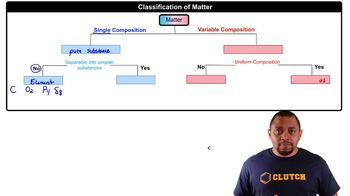
    Pure substances and mixtures.
  • What is a heterogeneous mixture?
    A mixture with visibly different components.
  • What are the six most important chemical elements of life?
    Carbon, hydrogen, nitrogen, oxygen, phosphorus, and sulfur.
  • Which substance is an example of a colloid?
    Milk is an example of a colloid.
  • What is alloy?
    An alloy is a homogeneous mixture of metals.
  • Which field of science studies the composition and structure of matter?
    Chemistry.
  • Shaving cream has gas dispersed throughout the cream. What type of mixture is this?
    Shaving cream is a colloid.
  • How are elements different from compounds?
    Elements are made of one type of atom; compounds are made of two or more different elements chemically bonded.
  • Which type of substance cannot be separated physically?
    Pure substances (elements and compounds) cannot be separated physically.
  • Which is a characteristic of mixtures?
    Mixtures can be separated by physical means.
  • What is a homogeneous mixture?
    A mixture with a uniform composition throughout.
  • Why is it important to know the properties of matter?
    Knowing properties helps identify, classify, and use substances appropriately.
  • Which type of matter can be physically separated?
    Mixtures can be physically separated.
  • What is an example of a mixture?
    Air is an example of a mixture.
  • Air is what type of mixture?
    Air is a homogeneous mixture.
  • Is a heterogeneous mixture a solution? How do you know?
    No, a solution is homogeneous; a heterogeneous mixture has visibly different components.
  • How is an element different from a compound?
    An element contains only one type of atom; a compound contains two or more different elements chemically bonded.
  • What is the main difference between an element and a compound?
    Elements are made of one kind of atom; compounds are made of two or more different elements.
  • Which sample of matter can be separated into two different substances by physical means?
    A mixture can be separated by physical means.
  • Is milk a pure substance or a mixture?
    Milk is a mixture.
  • Which is an example of a mixture?
    Soil is an example of a mixture.
  • Which characteristic applies to all mixtures?
    Mixtures have variable composition.
  • Which type of butter is a mixture of butter and oil?
    Blended butter is a mixture of butter and oil.
  • Which of the following are examples of inorganic compounds?
    Compounds not containing carbon-hydrogen bonds, such as NaCl or CO2.
  • How does the composition of a pure compound differ from that of a mixture?
    A pure compound has a fixed composition; a mixture has variable composition.
  • How does an element differ from a compound?
    An element is made of one type of atom; a compound is made of two or more different elements.
  • How does a compound differ from an element?
    A compound contains two or more different elements chemically bonded; an element contains only one type of atom.
  • Is mouthwash an element?
    No, mouthwash is a mixture.
  • Which of the following is a mixture?
    Gasoline is a mixture.
  • Which best describes a mixture?
    A mixture is matter composed of two or more substances physically combined.
  • Which is the term for matter that has a definite and uniform composition?
    Pure substance.
  • Which of the following describes inorganic molecules?
    Inorganic molecules do not contain carbon-hydrogen bonds.
  • Which property describes a mixture?
    Mixtures have variable composition.
  • How do elements and compounds compare?
    Both are pure substances, but elements have one type of atom, compounds have two or more.
  • What is matter? Choose the best answer.
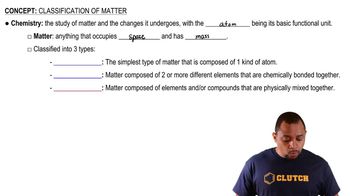
    Matter is anything that has mass and occupies space.
  • Which sample of matter can not be broken down by a chemical change?
    An element cannot be broken down by chemical change.
  • Which of these are not examples of matter?
    Energy forms like light and heat are not matter.
  • Which of the following best describes the difference between a mixture and a pure substance?
    A pure substance has a fixed composition; a mixture has variable composition.
  • Which of the following statements regarding matter is false?
    Matter does not occupy space is false.