Classification of Matter quiz #6 Flashcards

Classification of Matter quiz #6
Control buttons has been changed to "navigation" mode.
1/40
  • How many layers will a heterogeneous mixture have?
    A heterogeneous mixture can have two or more layers.
  • Which of these is a pure substance?
    Gold is a pure substance.
  • What do you think a characteristic of a pure substance could be?
    A pure substance has a uniform and definite composition.
  • Which material is a pure substance?
    Copper is a pure substance.
  • Which sample of matter can be separated into different substances by physical means?
    A mixture can be separated by physical means.
  • The drawing shows two water molecules. Which statement is correct?
    Each water molecule is a compound made of two hydrogen atoms and one oxygen atom.
  • Which can be broken down chemically into simpler substances?
    Compounds can be broken down chemically into simpler substances.
  • What is the difference between a colloid and a suspension?
    Colloids have particles that do not settle out; suspensions have particles that settle out over time.
  • How do we classify matter?
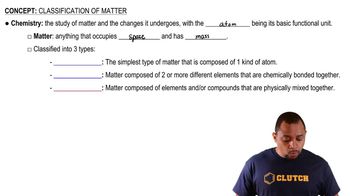
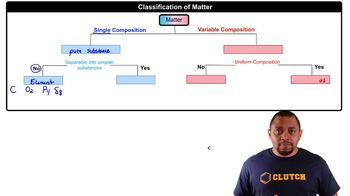
    Matter is classified as pure substances (elements and compounds) and mixtures (homogeneous and heterogeneous).
  • Which substances are inorganic compounds?
    Compounds not containing carbon-hydrogen bonds, such as NaCl or CO2.
  • What type of colloid is a pearl?
    A pearl is a solid colloid.
  • Which of the following is not a compound?
    Oxygen (O2) is not a compound; it is an element.
  • In the classification of matter,
    Matter is classified as pure substances and mixtures.
  • Which is an example of a homogeneous mixture?
    Salt water is a homogeneous mixture.
  • What is defined as anything made up of atoms that has mass and takes up space?
    Matter.
  • Which properties describe all matter?
    All matter has mass and occupies space.
  • What is the difference between a pure substance and a mixture?
    A pure substance has a fixed composition; a mixture has variable composition.
  • Which of the following are considered pure substances?
    Elements and compounds.
  • Which of the following is not true about mixtures?
    Mixtures have a fixed composition is not true.
  • In a homogeneous mixture everything is going to be located where?
    Evenly distributed throughout the mixture.
  • Which of the following is not a molecule?
    A single atom, such as helium, is not a molecule.
  • What are two types of pure substances?
    Elements and compounds.
  • Which of these is best classified as a mixture?
    Soil is best classified as a mixture.
  • What is not matter?
    Energy forms like light and sound are not matter.
  • Is aspirin a substance?
    Yes, aspirin is a pure compound.
  • What type of material is defined as having a well-ordered atomic structure?
    A crystalline solid.
  • Is a heterogeneous mixture a solution?
    No, a solution is a homogeneous mixture.
  • Which of the following is not considered a form of matter?
    Heat is not a form of matter.
  • Which of the following is a substance?
    Water is a substance.
  • Which of the following is an example of a homogeneous mixture?
    Air is an example of a homogeneous mixture.
  • Which container holds a pure substance?
    A container with only one type of particle, such as pure water.
  • Which of the following substances is a compound?
    Carbon dioxide (CO2) is a compound.
  • Which is not an example of matter?
    Sound is not matter.
  • Why can a solution be classified as a mixture?
    A solution contains two or more substances physically combined.
  • What is a main difference between a mixture and a pure substance?
    A mixture has variable composition; a pure substance has fixed composition.
  • Which statement best defines the term 'amorphous' when used to describe a solid?
    An amorphous solid lacks a well-ordered atomic structure.
  • Which will settle out if allowed to sit on a table: a suspension, a colloid, a solution, a compound?
    A suspension will settle out.
  • What are two different ways to classify matter?
    Matter can be classified as pure substances or mixtures.
  • What are the four most common elements that make up the earth's crust?
    Oxygen, silicon, aluminum, and iron.
  • What is the difference between a homogeneous and a heterogeneous mixture?
    Homogeneous mixtures have uniform composition; heterogeneous mixtures have visibly different components.