Collision Theory definitions Flashcards
Collision Theory definitions
You can tap to flip the card.
Control buttons has been changed to "navigation" mode.
1/15
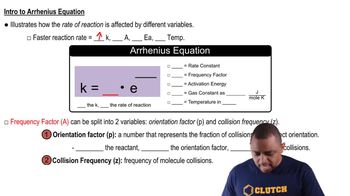
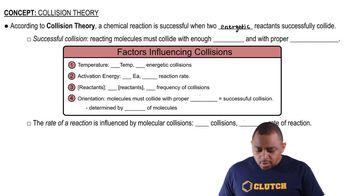
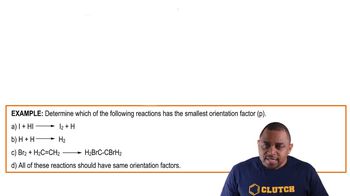
Collision TheoryA theory stating that chemical reactions occur when reactant molecules collide with sufficient energy and proper orientation.Activation EnergyThe minimum energy required for reactants to successfully collide and form products in a chemical reaction.TemperatureA factor that increases the energy of molecular collisions, thus enhancing the reaction rate.ConcentrationThe amount of reactant molecules present, influencing the frequency of collisions and reaction rate.OrientationThe specific alignment of molecules during a collision that determines the success of a chemical reaction.Arrhenius EquationAn equation that relates the rate constant of a reaction to temperature, activation energy, and frequency factor.Rate Constant (K)A value that indicates the speed of a chemical reaction, influenced by temperature and activation energy.Frequency Factor (A)A component of the Arrhenius equation representing the frequency of collisions and orientation factor.Gas Constant (R)A constant used in the Arrhenius equation, typically 8.314 J/(mol·K), relating energy to temperature.Orientation Factor (P)A fraction representing the proportion of collisions with the correct orientation for a successful reaction.Collision Frequency (Z)The number of molecular collisions occurring per unit time, affecting the likelihood of successful reactions.Molecular ShapeThe 3D arrangement of atoms in a molecule, affecting orientation and success of collisions.Reaction RateThe speed at which reactants are converted into products, influenced by collision frequency and energy.Energetic CollisionsCollisions where molecules have sufficient energy to overcome activation energy and react.Successful CollisionA collision where reactant molecules meet with enough energy and correct orientation to form products.