Chemistry Gas Laws: Combined Gas Law quiz #1 Flashcards
Chemistry Gas Laws: Combined Gas Law quiz #1
You can tap to flip the card.
Control buttons has been changed to "navigation" mode.
1/10
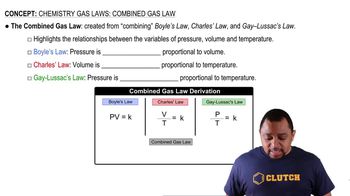
What is the proper form of the combined gas law equation?The proper form of the combined gas law is (P × V) / T = constant, or when comparing two states: (P1 × V1) / T1 = (P2 × V2) / T2.The combined gas law relates which variables?The combined gas law relates pressure, volume, and temperature of a gas.Which variable is assumed to be constant in the combined gas law?The amount of gas (number of moles) is assumed to be constant in the combined gas law.Which equation represents the combined gas law?The equation (P1 × V1) / T1 = (P2 × V2) / T2 represents the combined gas law.Which equation is derived from the combined gas law?The equation (P1 × V1) / T1 = (P2 × V2) / T2 is derived from the combined gas law.A gas occupies 40.0 L at 150 K. What volume does it occupy at 300 K, assuming pressure and amount of gas are constant?Using Charles's Law (V1/T1 = V2/T2): V2 = V1 × (T2/T1) = 40.0 L × (300 K / 150 K) = 80.0 L.Which three individual gas laws are combined to form the combined gas law?The combined gas law is formed by combining Boyle's Law, Charles's Law, and Gay-Lussac's Law.How does Boyle's Law describe the relationship between pressure and volume?Boyle's Law states that pressure is inversely proportional to volume for a given amount of gas at constant temperature.What does the constant 'k' represent in the combined gas law equation?The constant 'k' represents a fixed value for a given amount of gas, assuming no change in the number of moles.Why is temperature placed in the denominator in the combined gas law equation?Temperature is in the denominator because both Charles's Law and Gay-Lussac's Law relate temperature directly to volume and pressure, respectively.