De Broglie Wavelength quiz #1 Flashcards

De Broglie Wavelength quiz #1
Control buttons has been changed to "navigation" mode.
1/10
  • What did de Broglie propose to account for the fixed energy levels in Bohr’s model of the atom?
    De Broglie proposed that electrons have wave-like properties and that only certain standing wave patterns (with specific wavelengths) are allowed in atoms, which explains the fixed energy levels in Bohr’s model.
  • At what speed does an electron have a de Broglie wavelength of 1.0 nm?
    Using the de Broglie equation λ = h/(mv), and substituting λ = 1.0 nm (1.0 x 10⁻⁹ m), h = 6.626 x 10⁻³⁴ J·s, and the mass of an electron m = 9.11 x 10⁻³¹ kg, the speed v = h/(mλ) = (6.626 x 10⁻³⁴)/(9.11 x 10⁻³¹ x 1.0 x 10⁻⁹) ≈ 7.27 x 10⁵ m/s.
  • What is the speed of an electron if its de Broglie wavelength is 0.250 nm?
    Using the de Broglie equation λ = h/(mv), with λ = 0.250 nm (2.50 x 10⁻¹⁰ m), h = 6.626 x 10⁻³⁴ J·s, and m = 9.11 x 10⁻³¹ kg, the speed v = h/(mλ) = (6.626 x 10⁻³⁴)/(9.11 x 10⁻³¹ x 2.50 x 10⁻¹⁰) ≈ 2.91 x 10⁶ m/s.
  • What does the de Broglie equation relate in terms of an object's properties?
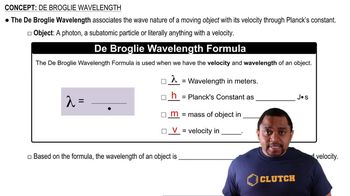
    The de Broglie equation relates an object's wavelength to its mass and velocity using Planck's constant.
  • What is the value and unit of Planck's constant used in the de Broglie equation?
    Planck's constant is 6.626 x 10⁻³⁴ joule·seconds (J·s).
  • How does increasing the mass of an object affect its de Broglie wavelength?
    Increasing the mass of an object decreases its de Broglie wavelength, since wavelength is inversely proportional to mass.
  • For which types of objects can the de Broglie wavelength be calculated?
    The de Broglie wavelength can be calculated for any object with velocity, including photons, subatomic particles, and macroscopic objects.
  • What is the unit for wavelength in the de Broglie equation?
    The unit for wavelength in the de Broglie equation is meters (m).
  • Why is the de Broglie wavelength important in quantum mechanics?
    It is important because it explains the wave-particle duality of matter and helps describe phenomena like electron diffraction.
  • What happens to the de Broglie wavelength if the velocity of an object increases?
    If the velocity increases, the de Broglie wavelength decreases, due to their inverse relationship.