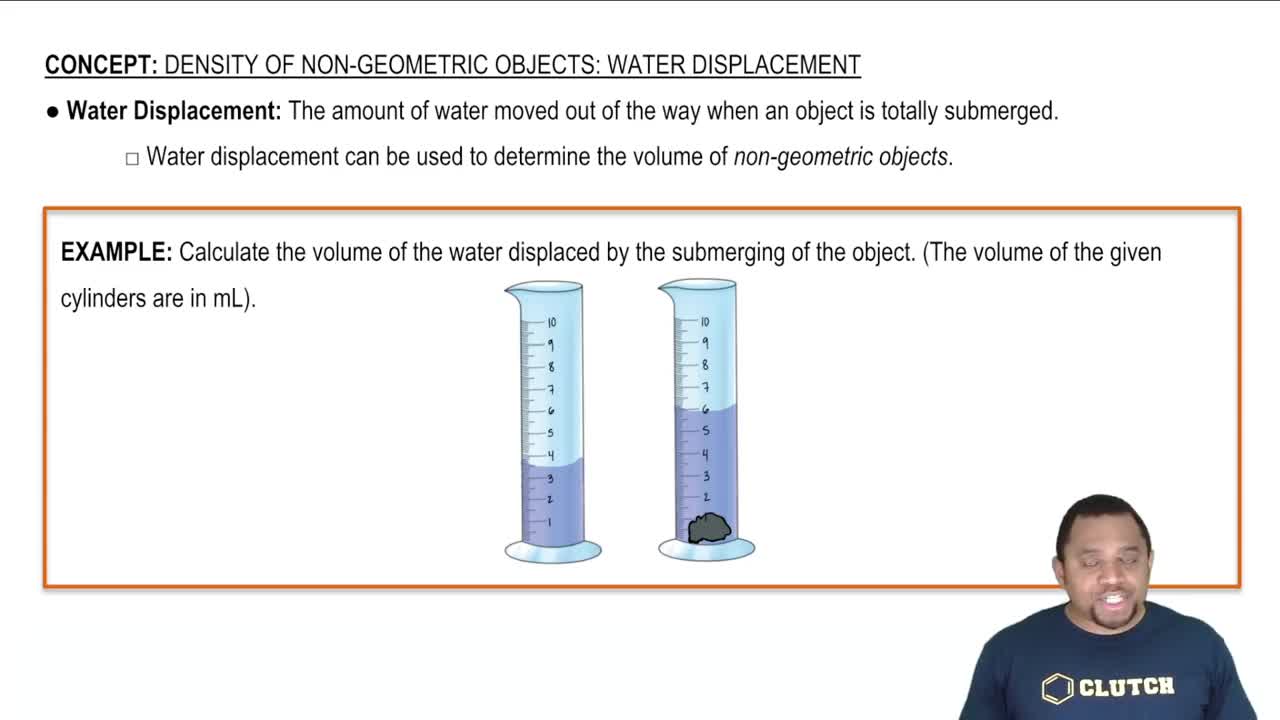
How do you determine the volume of an irregularly shaped object?
You determine the volume of an irregularly shaped object by using water displacement. Submerge the object in water and measure the change in water level; the difference is the object's volume.
What volume of ice is created from 200 cm³ of water, assuming no change in mass during freezing?
The volume of ice created from 200 cm³ of water will be slightly greater than 200 cm³ because ice is less dense than liquid water. However, the mass remains the same; only the volume increases due to the lower density of ice.
Which of the following methods would allow you to find the volume of an irregularly shaped solid object?
Water displacement is the method that allows you to find the volume of an irregularly shaped solid object.
How would you measure the volume of an oddly-shaped object?
To measure the volume of an oddly-shaped object, submerge it in water and calculate the difference between the initial and final water levels; this difference is the object's volume.
What is the definition of water displacement in the context of measuring volume?
Water displacement refers to the amount of water moved out of the way when an object is fully submerged, which equals the object's volume.
Why is water displacement especially useful for non-geometric objects?
Water displacement is useful for non-geometric objects because their irregular shapes make it difficult to use standard volume formulas, but submerging them allows for accurate measurement.
If the initial water level in a graduated cylinder is 3.5 mL and rises to 5.8 mL after submerging an object, what is the volume of the object?
The volume of the object is 2.3 mL, calculated by subtracting the initial volume from the final volume (5.8 mL - 3.5 mL).
What units are commonly used when measuring volume by water displacement in a laboratory setting?
Milliliters (mL) are commonly used to measure volume by water displacement in laboratory settings.
How does the water level change when a non-geometric object is submerged in a graduated cylinder?
The water level rises by an amount equal to the volume of the submerged object.
What is the first step in determining the volume of a non-geometric object using water displacement?
The first step is to record the initial volume of water in the graduated cylinder before submerging the object.