Back

Density quiz

Control buttons has been changed to "navigation" mode.
1/23
  • What is the difference between population size and population density?

    Population size refers to the total number of individuals in a population, while population density is the number of individuals per unit area or volume.
  • What is an example of a density-dependent factor?

    Disease
  • In general, how does density relate to the states of matter?

    Solids and liquids are generally denser than gases, meaning they have more mass per unit volume.
  • What is density in the context of chemistry?

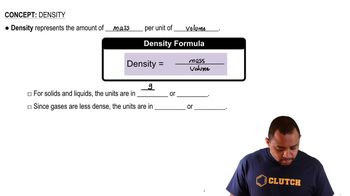
    Density is the mass of a substance divided by its volume, typically expressed in units like g/mL or g/cm³ for solids and liquids, and g/L for gases.
  • Which is more plentiful on Earth: solids, liquids, or gases?

    Liquids, specifically water, are more plentiful on Earth's surface.
  • Which is the best estimate for the mass of a caterpillar? A) 1 gram B) 10 grams C) 100 grams D) 1000 grams

    B) 10 grams
  • What is an example of a dense material?

    Lead
  • Gram for gram, which substance is denser: water or ice?

    Water is denser than ice, which is why ice floats on water.
  • Which answer best describes why ice floats in liquid water?

    Ice floats in liquid water because it is less dense than water due to the structure of its molecules forming a lattice.
  • What describes the number of individuals in a population per unit area?

    Population density describes the number of individuals per unit area.
  • Per gram, which has a higher density: solids or gases?

    Solids generally have a higher density per gram compared to gases.
  • What is an example of a density-independent factor?

    Weather
  • What is the difference between population and population density?

    Population refers to the total number of individuals, while population density is the number of individuals per unit area.
  • What allows ice to float in water?

    Ice floats in water because it is less dense than liquid water.
  • In general, how does the density of a gas compare to that of a liquid?

    In general, gases have a lower density than liquids.
  • In general, how does temperature affect the density of a substance?

    In general, increasing temperature decreases the density of a substance as it expands.
  • What is the definition of density?

    It is mass divided by volume
  • Which instrument is used to determine relative cell density based on turbidity of a culture?

    A spectrophotometer is used to determine relative cell density based on turbidity.
  • What is G1 in the context of cell biology?

    G1 is a phase in the cell cycle where the cell grows and prepares for DNA replication.
  • How do scientists calculate population density?

    Population density is calculated by dividing the population size by the area they occupy.
  • In general, how does pressure affect the density of a gas?

    In general, increasing pressure increases the density of a gas as it compresses.
  • Gram for gram, which has a higher density: lead or aluminum?

    Lead has a higher density than aluminum gram for gram.
  • Which form of water has the highest density? A) Ice B) Liquid water C) Water vapor

    B) Liquid water