Electron Configurations of Transition Metals definitions Flashcards

Electron Configurations of Transition Metals definitions
Control buttons has been changed to "navigation" mode.
1/15
  • Transition Metals
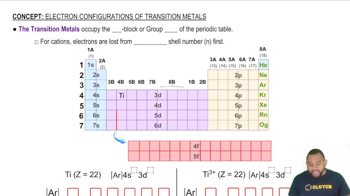
    Elements occupying the d block of the periodic table, often forming cations by losing electrons.
  • D Block
    Section of the periodic table where transition metals are located, characterized by filling d orbitals.
  • Cations
    Positively charged ions formed by losing electrons, often from the highest shell number.
  • Principal Quantum Number
    Denoted by n, it indicates the shell or energy level of an electron in an atom.
  • Atomic Number
    Number of protons in an atom's nucleus, determining its element and electron count when neutral.
  • Condensed Electron Configuration
    A shorthand notation using the previous noble gas to simplify electron configurations.
  • Pauli Exclusion Principle
    Quantum rule stating that no two electrons in an atom can have identical quantum numbers.
  • Hund's Rule
    Electrons fill degenerate orbitals singly first, with parallel spins, before pairing up.
  • Argon
    A noble gas with atomic number 18, used as a reference in condensed electron configurations.
  • 4s Orbital
    The orbital in the fourth shell where electrons are filled before 3d in transition metals.
  • 3d Orbital
    The orbital in the third shell filled after 4s in transition metals, crucial for their chemistry.
  • Electron Orbital Diagram
    Visual representation of electron distribution in an atom's orbitals, showing spin and occupancy.
  • Noble Gas
    Elements in group 18 of the periodic table, often used as a reference in electron configurations.
  • Degenerate Orbitals
    Orbitals with the same energy level, filled according to Hund's rule in electron configurations.
  • Electron Spin
    A quantum property of electrons, depicted as up or down, affecting orbital filling.