What is the net number of atoms located at the face centers in a face-centered cubic (FCC) unit cell?
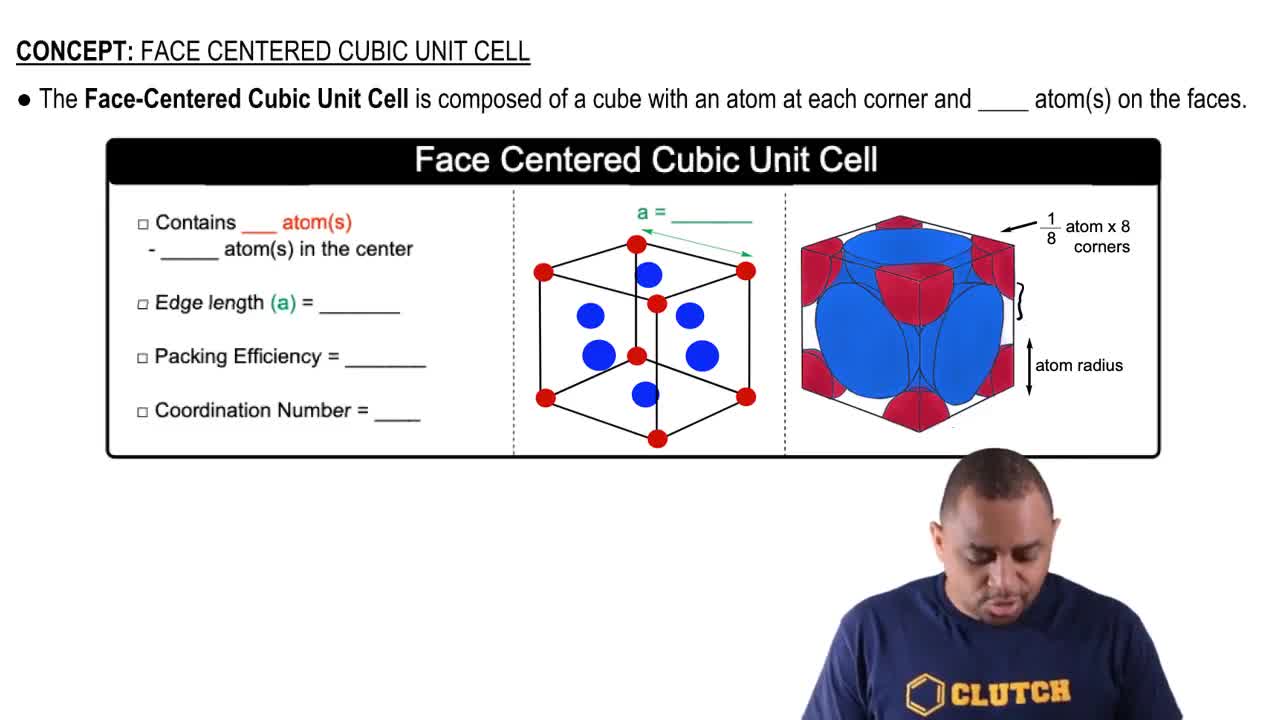
There are 3 net atoms at the face centers in a face-centered cubic unit cell. This is because each of the 6 face-centered atoms is shared between two unit cells, so each contributes 1/2 atom to the unit cell, resulting in 6 × 1/2 = 3 atoms.
How many total atoms are present in one face-centered cubic (FCC) unit cell?
There are 4 total atoms in one FCC unit cell: 1 from the corners and 3 from the face centers.
How is the contribution of corner atoms to the FCC unit cell calculated?
Each corner atom is shared among 8 unit cells, so each contributes 1/8 of an atom, resulting in 1 atom from all corners.
What is the formula for the edge length of an FCC unit cell in terms of atomic radius?
The edge length of an FCC unit cell is 2 times the square root of 2 times the atomic radius (2√2 r).
What is the packing efficiency of a face-centered cubic unit cell?
The packing efficiency of an FCC unit cell is 74%.
What does the coordination number of 12 mean in the context of an FCC unit cell?
A coordination number of 12 means each atom in the FCC unit cell is in contact with 12 other atoms.
How many face-centered atoms are present in an FCC unit cell, and how are they shared?
There are 6 face-centered atoms, each shared between 2 unit cells, so each contributes 1/2 atom.
Why is the edge length of an FCC unit cell not simply twice the atomic radius?
The edge length is not just 2r because the atoms are arranged such that the diagonal of the face passes through the centers of atoms, requiring the formula 2√2 r.
What structural feature distinguishes the FCC unit cell from other cubic unit cells?
The FCC unit cell has atoms at each cube corner and at the center of each face, unlike other cubic unit cells.
Why is understanding the FCC unit cell important in material science?
Understanding the FCC unit cell is crucial because its structure affects the properties of crystalline substances.