Skip to main content
General Chemistry
My Course
Learn
Exam Prep
AI Tutor
Study Guides
Textbook Solutions
Flashcards
Explore
Try the app
My Course
Learn
Exam Prep
AI Tutor
Study Guides
Textbook Solutions
Flashcards
Explore
Try the app
Back
Filtration and Evaporation quiz
You can tap to flip the card.
What is the main purpose of filtration in chemistry?
You can tap to flip the card.
👆
What is the main purpose of filtration in chemistry?
Filtration is used to separate an insoluble solid from a liquid in a mixture.
Track progress
Control buttons has been changed to "navigation" mode.
1/15
Related flashcards
Related practice
Recommended videos
Filtration and Evaporation definitions
Filtration and Evaporation
13 Terms
Filtration and Evaporation quiz
Filtration and Evaporation
10 Terms
Filtration and Evaporation quiz #1
Filtration and Evaporation
29 Terms
Filtration and Evaporation
4. BONUS: Lab Techniques and Procedures
10 problems
Topic
Extraction
4. BONUS: Lab Techniques and Procedures
10 problems
Topic
4. BONUS: Lab Techniques and Procedures
7 topics
15 problems
Chapter
Guided course
04:50
Filtration and Evaporation
4975
views
12
rank
Terms in this set (15)
Hide definitions
What is the main purpose of filtration in chemistry?
Filtration is used to separate an insoluble solid from a liquid in a mixture.
What is the solid left behind on the filter paper called after filtration?
The solid left behind is called the residue.
What do we call the liquid that passes through the filter paper during filtration?
The liquid that passes through is called the filtrate.
What common laboratory equipment is used to hold the filter paper during simple filtration?
A funnel is used to hold the filter paper.
Why is filter paper described as a semi-permeable membrane?
It allows the liquid (filtrate) to pass through but retains the solid (residue).
What is a practical, everyday example of filtration?
A coffee filter separates coffee grounds (residue) from liquid coffee (filtrate).
What is the main disadvantage of simple filtration using just a funnel and flask?
It is time-consuming and works best for solids that are not very dissolved.
What equipment is used for faster filtration and can help with recrystallization?
A vacuum pump with a Büchner funnel is used for faster filtration and recrystallization.
How does a vacuum pump speed up the filtration process?
It creates a vacuum that pulls the filtrate through the filter paper more quickly.
Why is vacuum filtration useful for partially dissolved solids?
The vacuum lowers the temperature, which helps recrystallize the dissolved solid.
What is evaporation (or crystallization) used for in separation techniques?
Evaporation separates a soluble solid from a liquid by vaporizing the solvent.
What equipment is typically used to heat the mixture during evaporation?
A Bunsen burner and an evaporation bowl are used.
What remains in the bowl after the evaporation process is complete?
Solid material remains after the liquid has vaporized.
How does evaporation differ from filtration in terms of the type of solid separated?
Evaporation is used for soluble solids, while filtration is for insoluble solids.
What property of the solvent is crucial for the evaporation technique to work?
The solvent must have a lower boiling point so it can be vaporized, leaving the solid behind.
 BackBack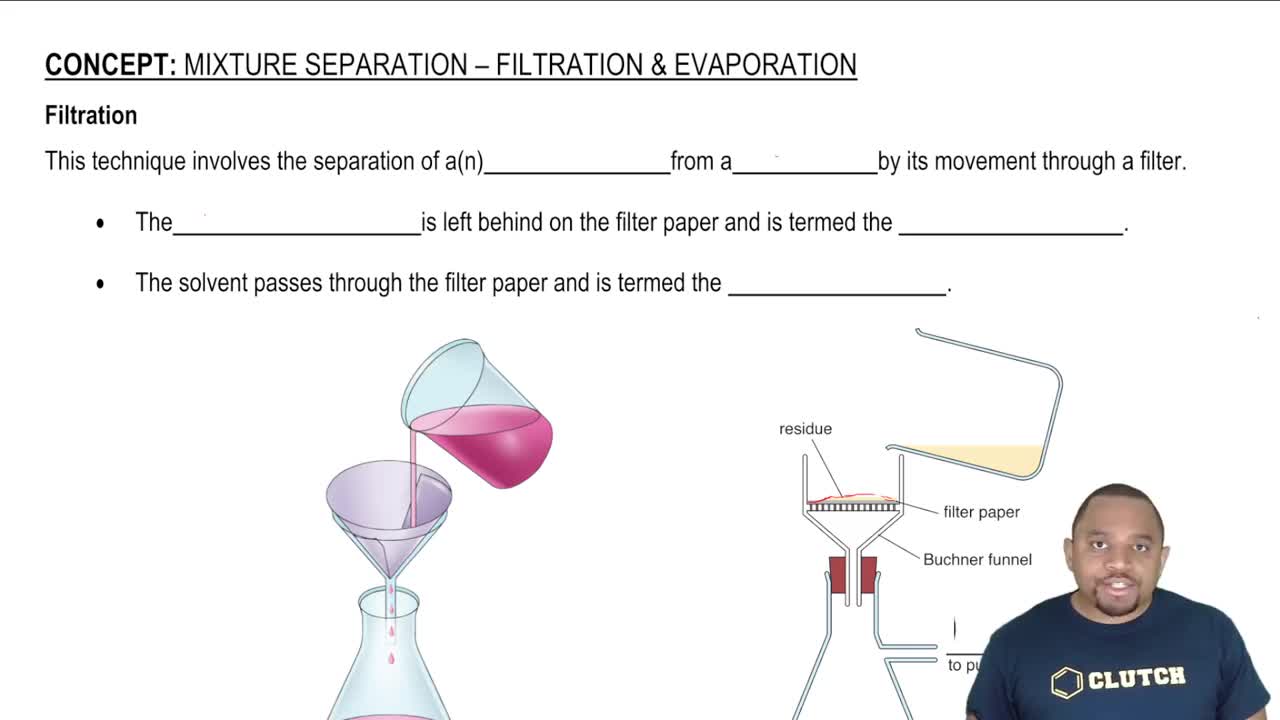
 04:50
04:50