Galvanic Cell definitions Flashcards

Galvanic Cell definitions
Control buttons has been changed to "navigation" mode.
1/15
  • Galvanic Cell
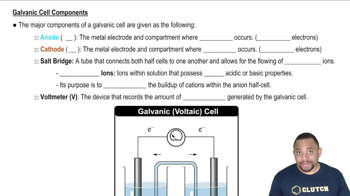
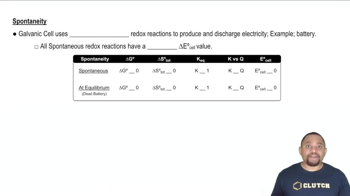
    A type of electrochemical cell that generates electricity through spontaneous redox reactions.
  • Anode
    The negatively charged electrode where oxidation occurs, losing electrons and decreasing in mass over time.
  • Cathode
    The positively charged electrode where reduction occurs, gaining electrons and increasing in mass over time.
  • Redox Reaction
    A chemical reaction involving the transfer of electrons, comprising oxidation and reduction processes.
  • Salt Bridge
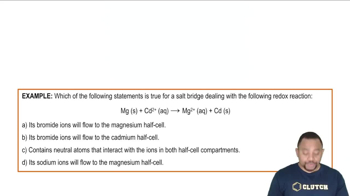
    A tube containing neutral ions that connects two half-cells, maintaining charge balance by neutralizing excess ions.
  • Standard Cell Potential
    The voltage difference between two electrodes in a galvanic cell, positive for spontaneous reactions.
  • Voltmeter
    A device that measures the voltage or electrical potential difference between two points in a circuit.
  • Electrode
    A conductor through which electricity enters or leaves a medium, such as the anode or cathode in a cell.
  • Neutral Ions
    Ions that do not exhibit acidic or basic properties, used in salt bridges to maintain charge neutrality.
  • Spontaneous Reaction
    A reaction that occurs naturally under given conditions, often with a positive cell potential.
  • Equilibrium
    A state where a galvanic cell has used all its electricity, with no net change in reactants or products.
  • Gibbs Free Energy
    A thermodynamic quantity representing the amount of energy available to do work, negative for spontaneous reactions.
  • Entropy
    A measure of disorder or randomness in a system, increasing in spontaneous processes.
  • Equilibrium Constant
    A ratio of product concentrations to reactant concentrations at equilibrium, greater than 1 for spontaneous reactions.
  • Conductive Wire
    A medium through which electrons flow from the anode to the cathode, generating electricity.