Gamma Emission definitions Flashcards

Gamma Emission definitions
Control buttons has been changed to "navigation" mode.
1/15
  • Gamma Emission
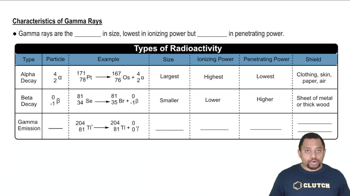
    A process where an excited atom emits a gamma ray, a high-energy photon, without changing its mass or atomic number.
  • Gamma Ray
    A high-energy photon with no mass or charge, part of the electromagnetic spectrum, emitted during gamma emission.
  • Photon
    A particle of light representing a quantum of electromagnetic energy, with no mass or charge.
  • Electromagnetic Spectrum
    The range of all types of electromagnetic radiation, including gamma rays, characterized by varying wavelengths and frequencies.
  • Thallium-204
    An isotope of thallium that can undergo gamma emission, remaining unchanged in mass and atomic number.
  • Excited State
    A condition where an atom's electrons occupy higher energy levels than the ground state, often preceding gamma emission.
  • Orbital
    A region around an atom's nucleus where electrons are likely to be found, changing during gamma emission.
  • Ionizing Power
    The ability of radiation to ionize atoms, with gamma rays having low ionizing power compared to other particles.
  • Penetrating Power
    The ability of radiation to pass through materials, with gamma rays having high penetrating power.
  • Alpha Decay
    A type of radioactive decay where an atom emits an alpha particle, often occurring alongside gamma emission.
  • Beta Decay
    A radioactive decay process where a beta particle is emitted, frequently accompanying gamma emission.
  • Lead Shielding
    A protective barrier made of lead, used to block the penetrating power of gamma rays.
  • Concrete Shielding
    A dense material used to protect against the high penetrating power of gamma rays.
  • Mass Number
    The total number of protons and neutrons in an atom's nucleus, unchanged during gamma emission.
  • Atomic Number
    The number of protons in an atom's nucleus, remaining constant during gamma emission.