Hess's Law quiz #1 Flashcards

Hess's Law quiz #1
Control buttons has been changed to "navigation" mode.
1/10
  • Which of the following best describes Hess's Law?
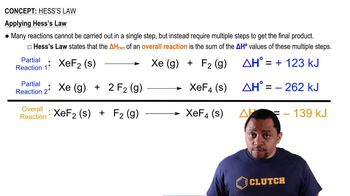
    Hess's Law states that the total enthalpy change for a chemical reaction is the same, regardless of the pathway or number of steps taken, as long as the initial and final conditions are the same.
  • According to Hess's Law, how can the enthalpy change for an overall reaction be determined?
    According to Hess's Law, the enthalpy change for an overall reaction can be determined by summing the enthalpy changes of individual steps that lead from the initial reactants to the final products.
  • What must be done to the enthalpy change (ΔH) when a thermochemical equation is multiplied by a factor?
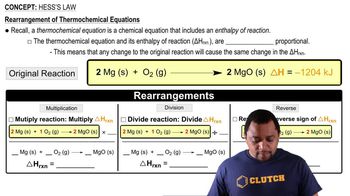
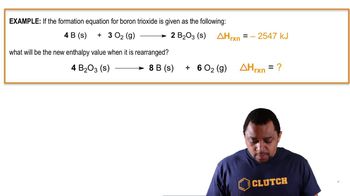
    The enthalpy change must be multiplied by the same factor as the equation's coefficients.
  • How does reversing a thermochemical equation affect its enthalpy change?
    Reversing the equation changes the sign of the enthalpy change; a negative ΔH becomes positive and vice versa.
  • What happens to the coefficients and enthalpy change when a thermochemical equation is divided by a number?
    Both the coefficients and the enthalpy change are divided by the same number.
  • Why do intermediate species cancel out when combining thermochemical equations using Hess's Law?
    Intermediate species cancel out because they appear as both reactants and products in the combined steps, leaving only the overall reactants and products.
  • What is a thermochemical equation?
    A thermochemical equation is a chemical equation that includes the enthalpy change (ΔH) for the reaction.
  • Why is Hess's Law useful for reactions that cannot be carried out in a single step?
    Hess's Law allows us to determine the overall enthalpy change by summing the enthalpy changes of multiple steps leading to the final product.
  • What must be true about the initial and final conditions for Hess's Law to apply?
    The initial and final conditions must be the same for the total enthalpy change to be independent of the reaction pathway.
  • How do you calculate the overall enthalpy change when combining partial reactions using Hess's Law?
    You add or subtract the enthalpy changes of the individual partial reactions to find the overall enthalpy change.